



- Forums
- Tools, Compressors and Metal Coatings
- Tools, Materials and Techniques
- Machining
- Machining Techniques and Materials
You are using an out of date browser. It may not display this or other websites correctly.
You should upgrade or use an alternative browser.
You should upgrade or use an alternative browser.
What are you machining?
- Thread starter Kram
- Start date

Erie Fred
Member
- Messages
- 7,052
- Location
- Erie, Pa USofA
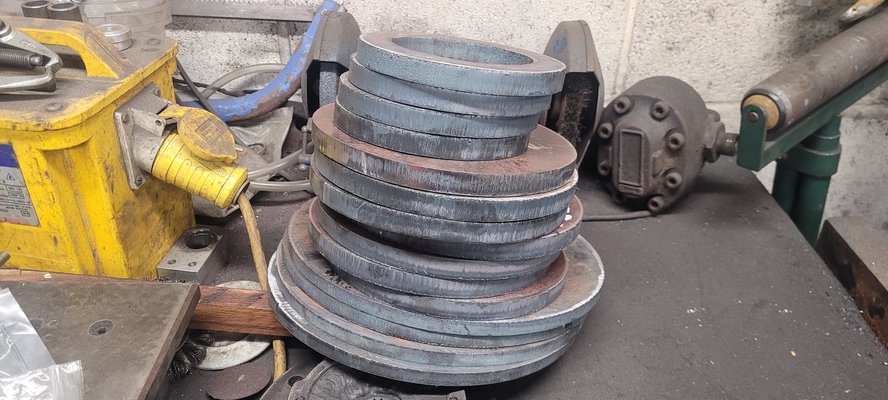
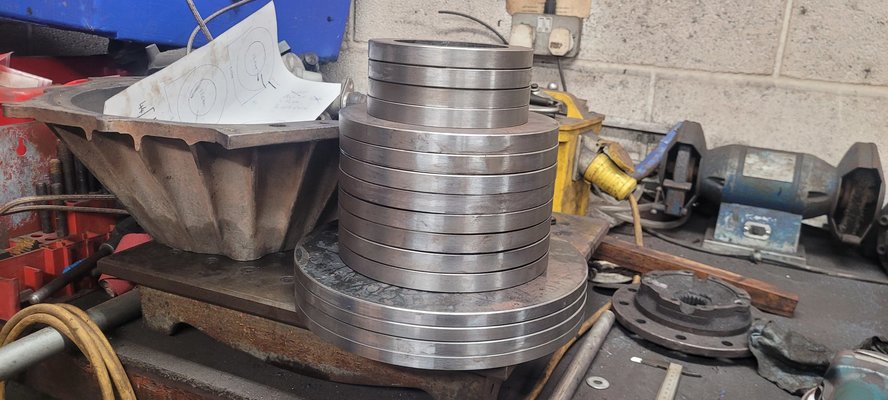
Cranking the tailstock ?yes. to be honest someone offered me some on linkedin for £80 delivered but it still needed machining down.
These took a while with HSS drills i'll be honest it surprised me how long i spent drilling.
I keep a few insert boring bars handy and have been known to exceed the min. dia. on them at times, when i tire
of using a drill.
Feed them in by hand slowly to keep chattering down and take out a large amount (3/8" on the side) and your golden.
Go back in for the next cut, speed things up, and use power feed.


Kram
Member
- Messages
- 8,952
- Location
- Sussex
Chainsaw sharpener, the main pivot had a lot of slop so decided to remake it.
The original pin was 7.9mm, I am replacing with 8mm silver steel rod, which I still need to chop to length
The outer housing bores were 8.5mm, Turned a pair of 0.23mm wall bushings. To do that I started with 12mm OD, bored 8.04mm first then a single cut to take 3.5mm off the OD to get 8.5mm. with a ccmt insert, the part only sees axial load so the thin wall wont be damaged.


The inner housing was 8.7mm ID
Drilled and reamed the inner housing to 10mm and turned another bushing 10mm OD, 8.04mm ID.

The original pin was 7.9mm, I am replacing with 8mm silver steel rod, which I still need to chop to length
The outer housing bores were 8.5mm, Turned a pair of 0.23mm wall bushings. To do that I started with 12mm OD, bored 8.04mm first then a single cut to take 3.5mm off the OD to get 8.5mm. with a ccmt insert, the part only sees axial load so the thin wall wont be damaged.
The inner housing was 8.7mm ID
Drilled and reamed the inner housing to 10mm and turned another bushing 10mm OD, 8.04mm ID.
oldbikedavey
Member
- Messages
- 2,209
- Location
- London, England
Westwood are good to deal with, or Gosnays might have some old scrap ones hanging about ..... ?One of the cylinder liner manufacturers like Laystall might be able to help.
@bR39Da
oldbikedavey
Member
- Messages
- 2,209
- Location
- London, England
Not so shabby !I've got in touch with the Eze-Sleeve people and their prices are reasonable
£27 for a 100mm cast iron sleeve with 1mm left on the internal diameter to be machined out once pressed in.


Maker
Most folk just call me; Orange Joe
- Messages
- 10,679
- Location
- Keeler crater
Once you try a toolpost mounted drill, you'll never go back to the tailstock. So much faster, especially retracting to clear chips, not to mention the DRO and power feed.Cranking the tailstock ?
I keep a few insert boring bars handy and have been known to exceed the min. dia. on them at times, when i tire
of using a drill.
Feed them in by hand slowly to keep chattering down and take out a large amount (3/8" on the side) and your golden.
Go back in for the next cut, speed things up, and use power feed.
What drill do you use?Once you try a toolpost mounted drill, you'll never go back to the tailstock. So much faster, especially retracting to clear chips, not to mention the DRO and power feed.
Kram
Member
- Messages
- 8,952
- Location
- Sussex
What drill do you use?
He means fitting a mt2/mt3 socket to the tool post. Without a DRO its a pain getting horizontally centered unless you can put something in the chuck first to centre the drill chuck. I rarely bother but it can be useful for holding a collet chuck. Tailstock doesnt let me use a draw bar but tool post does.
Maker
Most folk just call me; Orange Joe
- Messages
- 10,679
- Location
- Keeler crater
Morse taper QCTH as Kram says. I usually don't use the DRO to centre it, as long as its on centre height and there's turning marks on the face of the part, eyeballcentric is good enough. When it really matters (Small carbide drills basically) I'll use a DTI and get it perfect.What drill do you use?

Morrisman
Member
- Messages
- 9,064
- Location
- Staffordshire, England
When I worked in the machine shop one job was 6” diameter locking rings, 5 1/2” bore, acme thread, from 316 stainless. I used a trepanning tool, like a parting off tool but curved for clearance, and cut the centre out of each piece. They were maybe an inch thick and it cut okay.I'll show you wasteful next week. 150mm solid cast iron bar into a 3mm wall bearing sleeve. Criminal. I'm trying to find a supplier for the Cast iron EZE-Sleeves they have in america
First dozen or so I went halfway in from each side, but it was time consuming, so I tried a single cut straight through from one side, until I could feel it getting towards the end, compound slide would suddenly get easier to turn, and I’d back out before it came loose and locked up. Then I’d knock the centre out with a hammer. Then we had freebie chunks of 316 stainless for some other jobs.
Last edited:
Jelly_Sheffield
Time is an illusion. Lunchtime doubly so.
- Messages
- 1,461
- Location
- Sheffield, UK
If you're doing similar sized jobs often enough to justify the time investment, it's fairly straightforward to make insertable trepanning tools inexpensively in-house.Aye that's spun cast. Problem is we use so many different sizes of bearings it is in some ways easier to start with solid. Ideally we'd have some deep face grooving or trepanning tools to recover the core of the bar. It's something i'm looking into.
The EZE-Sleezes are cast iron, possibly spun, but premachined to suit common metric bearing sizes.
There was a guy who goes to my local pub who recently retired from running a one man deep hole and trepanning shop, made all his own tooling from a particular style of carbide insert and heavy wall tube.
He did actually post some how-to videos before he retired, but I can't find them again right now.
The upshot was he would:
• get some tube of approximately the correct size,
• mill two or three flutes down the outside,
• let in a section to clamp indexable lathe tools with countersunk screws level with the top of the flutes (because it's cheaper to replace them if an insert breaks deep in a cut),
• then weld a cap on the back with a BSP 3/4 I tapped hole for coolant,
• weld a toolholder on, either a large square bar to clamp in the Toolpost, or an MT7 to fit the powered tailstock on a turret lathe,
• for really long jobs he had a additional fixed steadies on most of the lathes with the bearings at 90° to the normal orientation to support the tool whilst starting a cut.
I think the key information which I'm unable to remember is which insert geometry he'd found most reliable.
Most days he'd have 3-5 lathes running with automatic feed trips, slowly chomping away at big trepanning jobs, whilst he was doing finish boring ops on "the good lathe", making up new tooling, or doing office stuff...
It would be great if you can find links to those videos etc.If you're doing similar sized jobs often enough to justify the time investment, it's fairly straightforward to make insertable trepanning tools inexpensively in-house.
There was a guy who goes to my local pub who recently retired from running a one man deep hole and trepanning shop, made all his own tooling from a particular style of carbide insert and heavy wall tube.
He did actually post some how-to videos before he retired, but I can't find them again right now.
The upshot was he would:
• get some tube of approximately the correct size,
• mill two or three flutes down the outside,
• let in a section to clamp indexable lathe tools with countersunk screws level with the top of the flutes (because it's cheaper to replace them if an insert breaks deep in a cut),
• then weld a cap on the back with a BSP 3/4 I tapped hole for coolant,
• weld a toolholder on, either a large square bar to clamp in the Toolpost, or an MT7 to fit the powered tailstock on a turret lathe,
• for really long jobs he had a additional fixed steadies on most of the lathes with the bearings at 90° to the normal orientation to support the tool whilst starting a cut.
I think the key information which I'm unable to remember is which insert geometry he'd found most reliable.
Most days he'd have 3-5 lathes running with automatic feed trips, slowly chomping away at big trepanning jobs, whilst he was doing finish boring ops on "the good lathe", making up new tooling, or doing office stuff...

Jelly_Sheffield
Time is an illusion. Lunchtime doubly so.
- Messages
- 1,461
- Location
- Sheffield, UK
I will try.It would be great if you can find links to those videos etc.
I have also seen another vid of the same thing from a guy (also in Sheffield), so I will see if I can dig up his as well/instead.
Maker
Most folk just call me; Orange Joe
- Messages
- 10,679
- Location
- Keeler crater
Not Dave Wilks by any chance?If you're doing similar sized jobs often enough to justify the time investment, it's fairly straightforward to make insertable trepanning tools inexpensively in-house.
There was a guy who goes to my local pub who recently retired from running a one man deep hole and trepanning shop, made all his own tooling from a particular style of carbide insert and heavy wall tube.
He did actually post some how-to videos before he retired, but I can't find them again right now.
The upshot was he would:
• get some tube of approximately the correct size,
• mill two or three flutes down the outside,
• let in a section to clamp indexable lathe tools with countersunk screws level with the top of the flutes (because it's cheaper to replace them if an insert breaks deep in a cut),
• then weld a cap on the back with a BSP 3/4 I tapped hole for coolant,
• weld a toolholder on, either a large square bar to clamp in the Toolpost, or an MT7 to fit the powered tailstock on a turret lathe,
• for really long jobs he had a additional fixed steadies on most of the lathes with the bearings at 90° to the normal orientation to support the tool whilst starting a cut.
I think the key information which I'm unable to remember is which insert geometry he'd found most reliable.
Most days he'd have 3-5 lathes running with automatic feed trips, slowly chomping away at big trepanning jobs, whilst he was doing finish boring ops on "the good lathe", making up new tooling, or doing office stuff...
Jelly_Sheffield
Time is an illusion. Lunchtime doubly so.
- Messages
- 1,461
- Location
- Sheffield, UK
Boom!It would be great if you can find links to those videos etc.
Couldn't find the first guy's videos, but the second chap still has a dormant YouTube channel with a bunch of good stuff: David Wilkes on YouTube
He uses W-shape inserts (I guess WPMX/WPMT/WBMT for clearance angles, but he doesn't say), whilst the other chap used some kind of dedicated "Turn, Face, Drill, Bore Insert" like a Multi-Turn or QCMT
Some footage of one of the setups I'm talking about in action, here at 17:21
Edit: Wrong video, This vid gives a good overview of him finishing the key steps in making up a new tool.
I assume the two blokes either trained at the same place or worked with the same people at some point, but it's possible they both independently arrived at the same idea because it's a neat solution to the problem.
Jelly_Sheffield
Time is an illusion. Lunchtime doubly so.
- Messages
- 1,461
- Location
- Sheffield, UK
He was the second guy I was thinking of, you posted just as I was finding his videos.Not Dave Wilks by any chance?
oldbikedavey
Member
- Messages
- 2,209
- Location
- London, England
Mostly , today , it has been a bit of old chair leg being thinned down to produce a suitably narrow runner core and pouring bowl for the sand casting of aluminium in Petrobond ...
Could quite get fond of using that wood turning lathe.
Could quite get fond of using that wood turning lathe.