Mick Annick
Forum Supporter
- Messages
- 3,104
- Location
- Burgundy, France (450 miles SE of Somerset)
More gates and railings, but at least welding was involved! The building in the background is my workshop, didn’t have far to travel to site 







The absolute worst thing to hit is a wire wall tie, the teeth keep getting caught up rather than cutting, especially if the wall is block, it crumbles just enough..Yesterday I made a 4" hole in the bathroom wall for a fan.
Should have been uneventful, apart from being over 70cm deep as it's through plasterboard, insulation, block, more insulation, cavity, then two layers of sandstone with a rubble fill.
You can see how deep the wall is, about 74cm
View attachment 520434
Weapon of choice, trusty Bosch corded drill. Eventually 3 extensions and screwfix's finest Erbaur 107mm core drill.
View attachment 520436
This model, I can see why it's called GBH2-26. When I did the daughter's ensuite last year, it went through a 90cm wall with a 6" core drill.
View attachment 520438
Anyway, started ok. Got about 40cm in, then slowed right down. I tried to take a pic down the hole but results didn't show the bit of metal it hit. It was at about 11 O'clock in the hole.
First of all, I thought it may be a wall tie, but this was in the rubble fill. Then I thought it may be an old gutter bracket, they used to use bars knocked between stones to hold the wooden gutters up. It wasn't the end of any lintel, it felt irregular and part of big piece of steel.
As I was angling downwards slightly, I thought the best approach was to push on and hope to get under it. I was somewhat invested by that time and trying to change direction or start a new hole would have been a pain as the target exit point is between a mullion and a stench pipe and just below the guttering.
View attachment 520439
Eventually, after a lot of effort, swearing, several cups of tea, a dog walk, I got through it. I did try removing it with a long chisel but it was having none of it. So I just kept breaking the core out and pushed on. The core drill still has plenty of life in it surprisingly.
View attachment 520437
Turns out to be a bit of scrap from when the steel beams were put in the roof of the barn conversion. The guy who did it cut them to size on site with oxy/propane. He must have had to cut a bit off and he shoved it in the cavity before we closed it up. He's retired now, that was 25 years ago but I still see him at the market for a coffe occasionally, I shall have a word.
Got there in the end, I would have liked it a bit higher on the wall but the roof is still sloping down, it came out in the right place which was the main thing.
Lovely view of the IBC taking water from the greenhouse roof.
View attachment 520435


Nice, I assume there isnt much about panel wise for these?Yet more repair patches for my MX-5 :-/
Nearside front of sill in 16 gauge / 1.5mm, so it needed a bit of whacking to shape.
Tigged a little gusset in to help it:
View attachment 520464
Swaged in the drains / stiffeners
View attachment 520465
I've found a copper hammer works well for forming bosses or recesses without adding too much hammer rash.
View attachment 520466
View attachment 520467
View attachment 520468
Just got to paint the insides and weld it up, then it's time for more...
ThanksNice, I assume there isnt much about panel wise for these?

 )
)
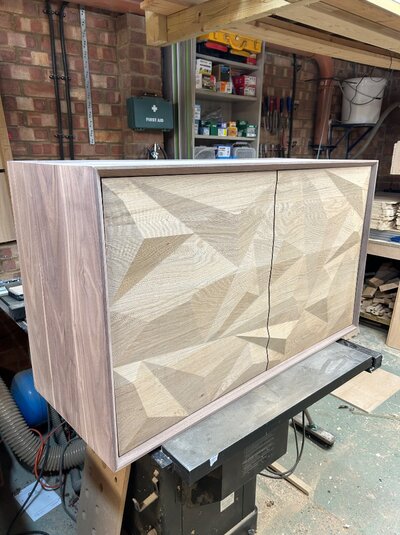

Finishing touches to the Walnut sideboard before it gets a coat of finish
View attachment 520513
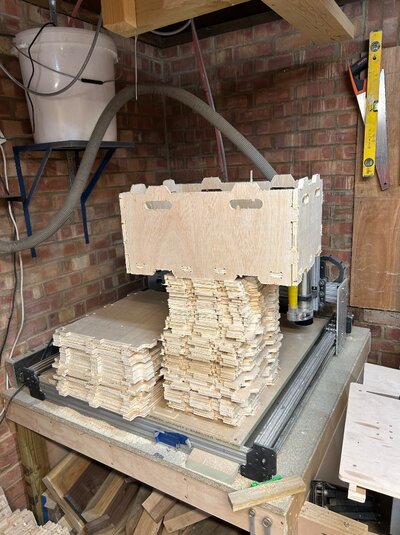
All while the poor little hobby CNC spent the day screaming its head off cutting 12mm ply into repetitive shapes to make up 20 wooden storage boxes for my dad who's moving hopefully soon and needs to pack up a very large workshop of stuff he cant be throwing away as he might need it one day
View attachment 520514
are the doors solid and machined to shape?Finishing touches to the Walnut sideboard before it gets a coat of finish
View attachment 520513
All while the poor little hobby CNC spent the day screaming its head off cutting 12mm ply into repetitive shapes to make up 20 wooden storage boxes for my dad who's moving hopefully soon and needs to pack up a very large workshop of stuff he cant be throwing away as he might need it one day
View attachment 520514
Yep. started out as 30mm thick oak and machined the face with the CNC. About 20 hours machining time between the 2 doors. My neighbours love me!!!are the doors solid and machined to shape?


Stuff the neighbours it looks fabYep. started out as 30mm thick oak and machined the face with the CNC. About 20 hours machining time between the 2 doors. My neighbours love me!!!

Stick a dehumdifier out side the shower room & leave it on 24/7 it will dry the air enough for it to drastically slow down the amount of heat required to get it to room temp thus actually saving you money for it will be cheaper than heating very humid air . The other benefit is it's likely that you avoid chest infections from mould in the home over winter.^ That's a job I have put off for another summer, my bathroom doesn't have an extractor fan so now the shower is on the higher power setting, it's getting a bit steamy and condensation-y. I suspect it will carry on until at least next spring as I've no desire to be opening up holes in the wall now the temperature has dropped. At least mine is an estate house from the late sixties, so I expect it will be a much simpler job. I hope so, anyway, as I don't have extensions or a massive powerful drill.
Stick a dehumdifier out side the shower room & leave it on 24/7 it will dry the air enough for it to drastically slow down the amount of heat required to get it to room temp thus actually saving you money for it will be cheaper than heating very humid air . The other benefit is it's likely that you avoid chest infections from mould in the home over winter.
Also try putting a core drill smack center into the roof ties fixing hole , the tie being 5 mm thick galv steel by 25 mm or so wide , I couldn't understand why the masonry bit pilot was not going through the block wall . I saw shiny steel in the hole , changed to a HSS twist drill . then hit the tie bar with the core drill just polishing the dam thing . Ended up disc cutting a 9 inch square and taking out a chunk of the offending tie bar then putting the 6 inch core drill through the wall after popping a 6 mm long masonry through the wall to guide the core drills masonry bit so I could cut from inside & outside without blowing the render off the outer wall .The absolute worst thing to hit is a wire wall tie, the teeth keep getting caught up rather than cutting, especially if the wall is block, it crumbles just enough..
We bought 2 last year, made a massive difference, seems to make the place warmer without the heating on just by taking moisture out of the air I guessCheers, I'll look into that. I was given a dehumidifier a couple of years back and couldn't really think of anything to do with it. I've just downloaded the manual for it to see how it works, so the next thing is to bring it inside and switch it on. It seems to gather water into a container rather than needing to send it outside. All I need to worry about is how much electricity it's going to take - I've already got to cope with seeing the daily smart meter numbers increasing now I've put the heating on for a bit longer each day.
The specific heat capacity of quite warm air at 25 degC and 100% relative humidity, is only marginally higher (about 3%) than that of completely dry air at the same temperature, so the difference in specific heat capacity of air at between something like 90% RH and 60% RH, which is the sort of reduction in humidity that might be produced by a dehumidfier, is going to be smaller still. On the other hand, the dehumidification process itself will be producing heat, adding to the output coming from the main heating system of the property.Stick a dehumdifier out side the shower room & leave it on 24/7 it will dry the air enough for it to drastically slow down the amount of heat required to get it to room temp thus actually saving you money for it will be cheaper than heating very humid air . The other benefit is it's likely that you avoid chest infections from mould in the home over winter.