yep thats all you would want and you would be happy to sleep at nightsMy welder dues structural stuff all over London, he has seen it all, so many cowboys. He is usually correcting mistakes in the steelwork or other peoples welding. Sometimes there are serval days welding and he only hire got a day, he knows it so they can use his certs, for it all and get someone cheaper to do the rest. He takes photos of just the bit he does. Occasionally he will walk away from a job as he didn’t want his name on it. He is good, £400+ vat for a day in London.
Here’s a joint I did a couple years ago, how I would have thought the op’s joint should look a bit like
View attachment 522895




You are using an out of date browser. It may not display this or other websites correctly.
You should upgrade or use an alternative browser.
You should upgrade or use an alternative browser.
Structural welds on residential property
- Thread starter ash1356
- Start date

addjunkie
Member
- Messages
- 14,746
- Location
- Northumberland. Reet oot in the sticks
Bout sums it up, we have a local Mr weld it all and anything from gates to just about anything you'd want, but I don't doubt that many folk who hire him, just assume he's a welder because it says so on his van. He used to do process pipework on offshore hook ups and boiler work so assume at some stage in the past he's been ASME IX.That always bugs me...
First of all, how the hell is Joe Bloggs, (or even Joe Bloggs' builder Stan D'round) going to know how to select a competent welder?
Secondly, even if they do find a competent welder, the guy is being selected for his ability to stick metal together...
They have hopefully learned what the best joint design to use in a given situation are, and how to choose between them properly...
But that's not at all guaranteed!
For every time-served welder who out of idle curiosity has accidentally taught themselves more materials science and mechanical design than most people with engineering degrees know...
There's someone who has tremendous skill with a torch/stinger and can perform any weld you tell them to perfectly... But who you wouldn't trust to make a gingerbread house without supervision lest they set fire to the kitchen.
And most everyone else sits somewhere in the middle.

Tigman
Forum Supporter
- Messages
- 3,906
- Location
- Watford UK
Round my way , building inspectors won't accept welding on site , if you have to do it they require a certificate , most places I've been we are asked for it ! The certificate should be relevent to the positional welds executed , so vertical , overhead fillets !
I don't have a current Cert , so I use a company that has , the certificate is signed by the welder and has a picture on it , of the said welder ,
I don't have a current Cert , so I use a company that has , the certificate is signed by the welder and has a picture on it , of the said welder ,
Tigman
Forum Supporter
- Messages
- 3,906
- Location
- Watford UK
To weld the inside of the steels are not easily accessible, very difficult , hence all the arc strikes very hard to see the joint through what looks like a 150mm gap , totally the wrong connection to be doing on site , drilled and cleated much better in that situation , in my opinion
I domt understand why it wasn't designed like this

Surely that's ideal? Even IF the welds and bolts all failed it still could catastrophically fall apart? Bit trickier to get the beam in as you'd have to insert it diagonally bit not impossible in the space in the original pics?
Surely that's ideal? Even IF the welds and bolts all failed it still could catastrophically fall apart? Bit trickier to get the beam in as you'd have to insert it diagonally bit not impossible in the space in the original pics?

Pete.
Forum Supporter
- Messages
- 15,100
- Location
- Kent, UK
Ideal is fin plates welded inside the web of the supporting joist and the secondaries bolted to it. I don't know why the structural engineer figured that a bolted connection could not carry the imposed load it's how the rest of the construction industry does it, and we're talking commercial buildings not residential. If a joist cannot be ficed up with bolts then something is under-specced.

gaz1
Member
- Messages
- 20,680
- Location
- westyorkshire
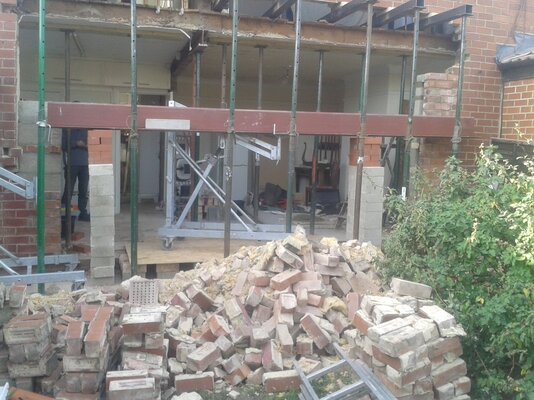
for what you have used it would have been better just to build a new concrete wall and fit a padstone on top of it for what its cost you to have those 2 beams fitted for the inner and outside walls on the original build of the house
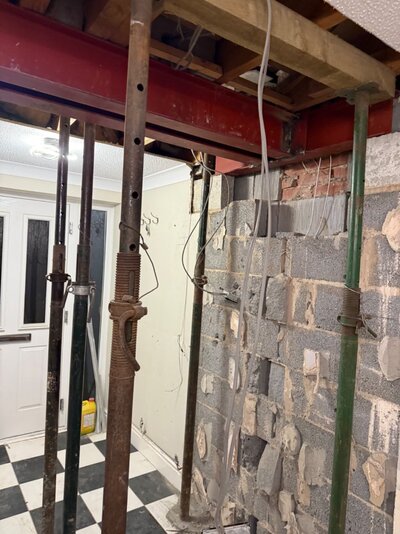
as goes for beams ours was bolted for a shop
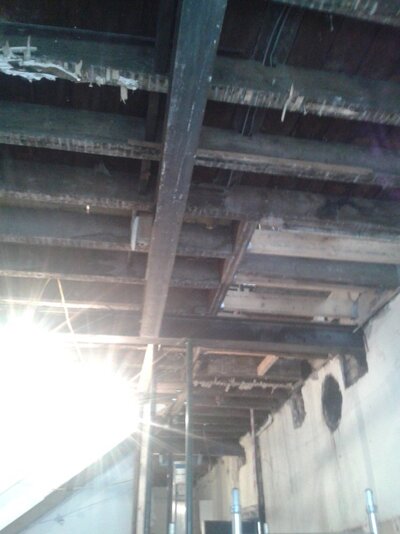
this one also bolted but the main holder is at front and a side one holding the bathroom/hallway floor concrete wall built the front is the mainbeam thats been lifted
as goes for beams ours was bolted for a shop
this one also bolted but the main holder is at front and a side one holding the bathroom/hallway floor concrete wall built the front is the mainbeam thats been lifted
I meant 'could not catastrophically' above, only mentioning otherwise my post seems a bit silly.I domt understand why it wasn't designed like this
View attachment 522912
Surely that's ideal? Even IF the welds and bolts all failed it still could catastrophically fall apart? Bit trickier to get the beam in as you'd have to insert it diagonally bit not impossible in the space in the original pics?
Sorry should’ve said in my post - There is doorway going underneath the small beam. The design did initially have a large lintel above the doorway and then the two beams sitting on top of the lintel but we didn’t have the head room to play with so had to change the designfor what you have used it would have been better just to build a new concrete wall and fit a padstone on top of it for what its cost you to have those 2 beams fitted for the inner and outside walls on the original build of the house
View attachment 522924
as goes for beams ours was bolted for a shop
View attachment 522925
this one also bolted but the main holder is at front and a side one holding the bathroom/hallway floor concrete wall built the front is the mainbeam thats been lifted
View attachment 522926
So I’ve now heard back from both building control and the structural engineer.
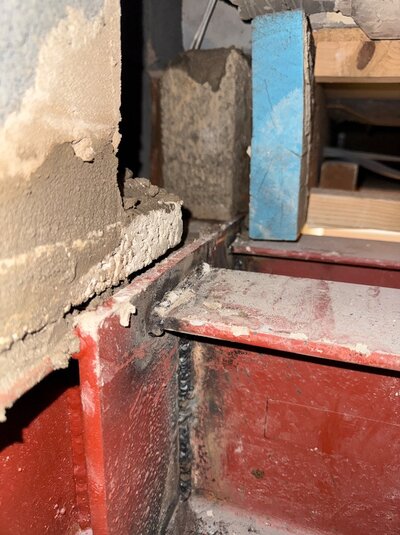
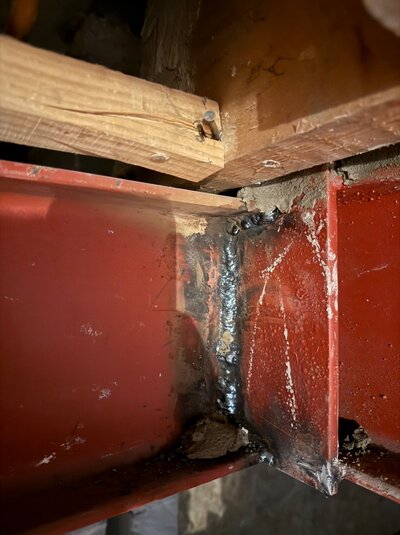
Both BC and engineer are happy with the welded connection. Only caveat to that is the top of the flanges and the inner flanges need to be welded.
The welder has not welded the top of one of the flanges due to access issues. See attached.
Both BC and engineer are happy with the welded connection. Only caveat to that is the top of the flanges and the inner flanges need to be welded.
The welder has not welded the top of one of the flanges due to access issues. See attached.

skotl
Forum Supporter
- Messages
- 10,528
- Location
- Edinburgh, UK
That doesn’t sound like a good outcome. Time to insist on another welder I think.So I’ve now heard back from both building control and the structural engineer.
Both BC and engineer are happy with the welded connection. Only caveat to that is the top of the flanges and the inner flanges need to be welded.
The welder has not welded the top of one of the flanges due to access issues. See attached.

Smallfry
HE's Spartacus.
- Messages
- 3,231
- Location
- Kent UK
Looks like it was done by the same guy that did the beams in our place !
It is open underneath and it irks me every time I look at it. I am no professional, but could do a lot better, and I will one day, once the floor above is lifted.
If its any consolation, the wall above that rests on it is heavyweight block, and it was done in 1984, and not fallen down yet.
It is open underneath and it irks me every time I look at it. I am no professional, but could do a lot better, and I will one day, once the floor above is lifted.
If its any consolation, the wall above that rests on it is heavyweight block, and it was done in 1984, and not fallen down yet.
addjunkie
Member
- Messages
- 14,746
- Location
- Northumberland. Reet oot in the sticks
Bottom covering as BC didn't query the design. Neither BC or engineer are welding inspection competent so how can they say its ok with a bit extra welding.So I’ve now heard back from both building control and the structural engineer.
Both BC and engineer are happy with the welded connection. Only caveat to that is the top of the flanges and the inner flanges need to be welded.
The welder has not welded the top of one of the flanges due to access issues. See attached.
Was on a couple of defence industry sites in California many years ago - all structural designs had to be submitted and approved for their earthquake codes. Any mods on site had to be approved and inspected by one of their guys.
Amazing how much welding was going on outside working hours . . .
Amazing how much welding was going on outside working hours . . .