Gingle
We are all in the same boat
- Messages
- 475
- Location
- England uk Cambridge



 .
.
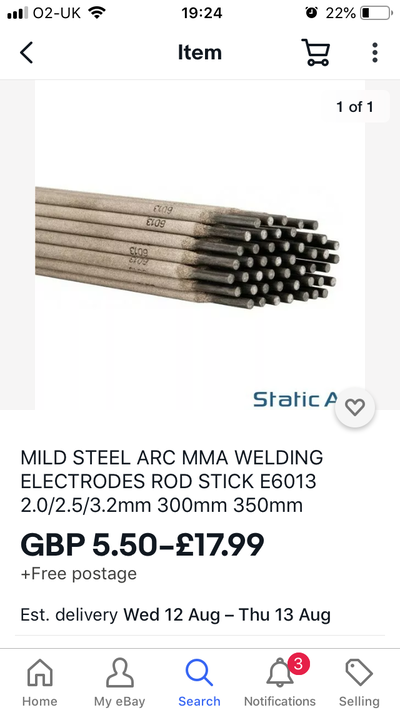
Thanks, and a good named rod please , at a reasonable price. Bought toolstashion rods , are a bit hit and missThe 6013s will be best for you
Esab, Murex, Lincoln, Oerlikon, Elga, BohlerThanks, and a good named rod please , at a reasonable price. Bought toolstashion rods , are a bit hit and miss

Fincord ,saf fro (probably the same as Lincoln since they acquired air liquide)Esab, Murex, Lincoln, Oerlikon, Elga, Bohler

Thats because they have changed supplier.......possibly chinese as most (or all) European manufacturers stopped doing green. The green dye is Chromium Oxide and we all know Cr is bad for you so why put some in just to make it coloured. Manufacturers have a very limited choice of colour additives because most dyes burn away at the baking temperatures (especially low hys) so red is iron oxide (and you will get some of that even if its not added) and a blue called Lake Blue which for a quirk can take the heat.....its relatives, yellow, green, red cant stand the heat.........you can get a yellow iron oxide but its expensive.....incidentally the Lake Blue is the dye used for Denim..I've never had any problems with Siftrode. I bought some 2.5s recently, the flux coating is now coloured green - they work a treat.
they are more rebadged stuff.....the problem being the next box maybe a different make altogetherGot these 2.5 magic , works much better than toolstAshion crap
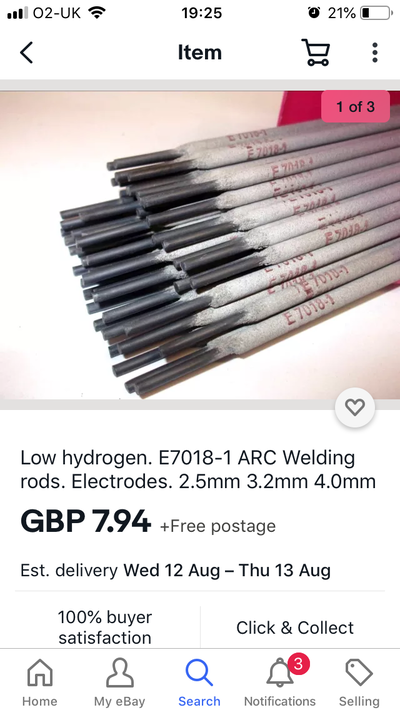
Low-hydrogen? When steel is molten, as in the weld pool, it readily absorbs hydrogen, as it cools, and begins to solidify, it rejects the hydrogen immediately, resulting in a weld deposit filled of miniscule 'worm holes'
6013 have a tensile strength of 60 000 lbs, 7018s have a tensile strength of 70 000 lbs, hence the removal, and control of hydrogen levels is to increase the weld tensile strength:
Hydrogen is present in water, H,2O, hence the need to keep all electrodes dry, preferably warm/hot; oxides, nitrides, carbides will also affect weld quality, this is why all plate, and weld area should have all mill scale, rust, paint, , oil, grease water, cutting fluid removed prior to attempting the weld

HYDROGENLow-hydrogen? When steel is molten, as in the weld pool, it readily absorbs hydrogen, as it cools, and begins to solidify, it rejects the hydrogen immediately, resulting in a weld deposit filled of miniscule 'worm holes'
6013 have a tensile strength of 60 000 lbs, 7018s have a tensile strength of 70 000 lbs, hence the removal, and control of hydrogen levels is to increase the weld tensile strength:
Hydrogen is present in water, H,2O, hence the need to keep all electrodes dry, preferably warm/hot; oxides, nitrides, carbides will also affect weld quality, this is why all plate, and weld area should have all mill scale, rust, paint, , oil, grease water, cutting fluid removed prior to attempting the weld
Ive got the 8th edition and it says something similar but not quite what you quotedThe science and practise of welding: A C Davies: seventh edition
Low-hydrogen? When steel is molten, as in the weld pool, it readily absorbs hydrogen, as it cools, and begins to solidify, it rejects the hydrogen immediately, resulting in a weld deposit filled of miniscule 'worm holes'
6013 have a tensile strength of 60 000 lbs, 7018s have a tensile strength of 70 000 lbs, hence the removal, and control of hydrogen levels is to increase the weld tensile strength:
Hydrogen is present in water, H,2O, hence the need to keep all electrodes dry, preferably warm/hot; oxides, nitrides, carbides will also affect weld quality, this is why all plate, and weld area should have all mill scale, rust, paint, , oil, grease water, cutting fluid removed prior to attempting the weld