



You are using an out of date browser. It may not display this or other websites correctly.
You should upgrade or use an alternative browser.
You should upgrade or use an alternative browser.
Repairing a stripped stud's thread.
- Thread starter ajlelectronics
- Start date


ajlelectronics
Forum Supporter
- Messages
- 11,311
- Location
- Gloucester, England
It has an Allen head to stop it spinning whilst moving the nut, so a plain welded stud wouldn't work.

MattF
Forum Supporter
- Messages
- 18,911
- Location
- South Yorkshire
If it were I, I'd simply buy another unit, but contact the supplier/manufacturer first & see if there's any chance of replacement from their end. Nowt to lose by asking. Obviously, get new nuts next time.
I personally wouldn't risk messing around with that.
I personally wouldn't risk messing around with that.
I'd sooner run a damaged M8 thread than any of the M6 options. @Agroshield 's suggestion of a tube nut to sit inside the top mount is probably the best solution on offer, assuming you can modify the top mount to accommodate it. It was used in a lot of kits for fitting mk2 top mounts to mk1 mx5 dampers from vendors of variable quality and I don't recall any reports of failures.
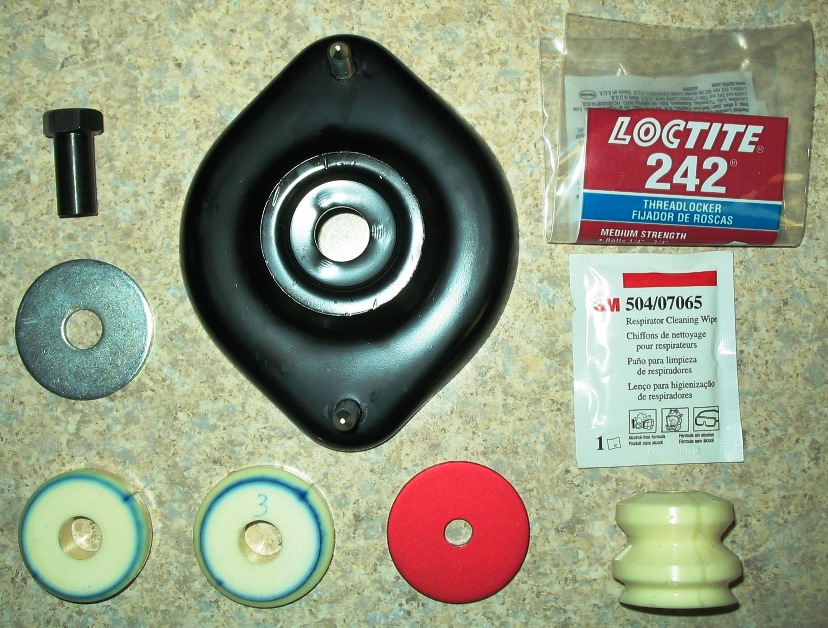
The adaptor setup is approved by the SCCA for SpecMiata race series too, apparently.
The adaptor setup is approved by the SCCA for SpecMiata race series too, apparently.
Agroshield
Member
- Messages
- 6,496
How would you thread it if the part is mounted to the cross slide?
I was thinking with a die. No actual threading on the lathe.
The lathe work just involves removing the old thread (all of it), reducing in diameter so the weld interface is not involved in the new thread, and then making the weld build up into an 8mm diameter cylinder.
With the nitrogen warning above, it might be wise to have the shock in a bucket of water or a wet rag around the shaft when welding it up.
You could do the (final) turning without a boring head. Hold a lathe tool in the four jaw and set it to touch/stratch the shaft on a part below that which you have repaired. Then wind the carriage towards the tailstock.

Nomad
Member
- Messages
- 2,460
- Location
- North Devon (for how long?)
Going from M8 to M6 is quite a big change.
M7 would be less of a change, plenty of nuts available, I bought some from my local motorbike workshop (M7 is common on some exhaust studs - Piaggio etc..)
Most of the load will be when the shock compresses so no load on the nut then, the nut is only used when the shock extends.
Is this for a gently driven town car or a competition off-roader?
M7 would be less of a change, plenty of nuts available, I bought some from my local motorbike workshop (M7 is common on some exhaust studs - Piaggio etc..)
Most of the load will be when the shock compresses so no load on the nut then, the nut is only used when the shock extends.
Is this for a gently driven town car or a competition off-roader?
ajlelectronics
Forum Supporter
- Messages
- 11,311
- Location
- Gloucester, England
I have adjusted the shock absorber as short as it will go. It is now far shorter than factory and I suspect that it will affect the handling. The rear unit must have the spring seat set too high but it (although threaded) claims not to be adjustable.
The suppliers are highly unlikely to be helpful in my experience of not putting their hands up.
Top thread...

The suppliers are highly unlikely to be helpful in my experience of not putting their hands up.
Top thread...

Gareth J
Forum Supporter
- Messages
- 3,945
- Location
- North Cornwall
Run a die down over that to clear up damage and fit two nuts. Or a long nut as posted before. The damaged bits will reduce the strength of the fastner but a double nut will more than compensate.
Leaving the burrs in place risks damaging the nut on the way on and then the threads moreso on the way off again.
Leaving the burrs in place risks damaging the nut on the way on and then the threads moreso on the way off again.