I am wanting to contact brad93 about the archdale mill I am trying to restore one the same and am trying to work out how the clutch assembly comes off the main drive shaft. I can not find any litriture on this machine . Hope you can help. Colin

You are using an out of date browser. It may not display this or other websites correctly.
You should upgrade or use an alternative browser.
You should upgrade or use an alternative browser.
Ideas For Level Sensor
- Thread starter Brad93
- Start date
Having had a quick look at the datasheet for that, the 600mA is the rating for a resistive load.
A relay is an inductive load, which could cause the contacts to burn out faster.
There is also the possibility that the load was too low, which can result in not enough arcing on the contacts to keep them clean.
hmm...
would a low power bulb in parallel with the relay sort that?

gaz1
Member
- Messages
- 20,515
- Location
- westyorkshire
i like yours but what about mag switches instead as your switch is more confined compared to a drop ball on an armI've used capacitance ones through tank side walls for controlling pumped caustic. Worked well.
This is a quick shot of a level switch assembly used by a US company I started work for in '99 - a rummage in my drawers produced a drawing:
View attachment 500145
Stainless steel ball float, rod, collar etc. Exactly the same idea as the UK company had (except they used three switches - in descending order - operating level, fill level (ie call for fill) and low level (stop machine, sound alarm to protect pump, heaters etc). The only time they didn't work reliable was aireated water, or extreme foam - they would then just sit on low level as the float didn't . . .
One of the floats we used was made from chipati tins - lid and base tigged up - cheap, worked, and available just up the road from our factory in Bradford).
Conductance probes worked pretty well (could even use the tank as one of the electrodes) - but if they get covered in crap, as I suspect the flux might do, you get false readings.
Only used a few ultrasonic level sensors - they were sod ding expensve over 20 yrs ago and customers didn't like paying for them.
Gaz's ball float valve - might not be as daft, although I suspect "gloopy flux" might not allow it to work as well as hoped - any seals in there won't be happy either. But certainly still used in industry as a cheap, quick, pretty reliable method of tank level control (one of our competitors does - our equivalent has been attacked by someone with shares in IFM . . . )
I'm a little surprised the original was using a 230V tilt switch - I'm mechanical, but that doesn't seem a "safe" voltage to be using for control- 24V being more usual?
magnetic switches
but i think yours might hit the same issue mine does by sticking to the material in its cold form whilst its hot neither system will have any trouble performing
whilst the ball will drop hard enough when the material drops
whilst i also say copper ball im not so sure with the stainless steel ball or even steel ball
i do know with copper it just cleans the metal does the brown flux whilst the white flux is more acid based
however with copper it just turns the copper green im not so sure what would happen with the steel or stainless steel ball
No @Brad93 , just get a milltronics (Siemens) or hycontrol level controller, everything in one unit - relays, mA output, switching points, averaging to slow the response, 110, 240 or loop powered. I've fitted and used hundreds over the years, they are super reliable and easy to use. Get a temperature compensated head if the gloop temperature varies a lot and the absolute switching points are critical.I think non contact ultrasonic is the way to go.
Right then, small plc needed then
I'd probably use a SSR (Solid State Relay), then possibly add a resistor in parallel to make sure there's a bit load on the contacts (probably aim for 60-100mA, although less would probably be fine, so you've got at least 20mA or so).hmm...
would a low power bulb in parallel with the relay sort that?
What size of relay were you switching?
I'd probably use a SSR (Solid State Relay), then possibly add a resistor in parallel to make sure there's a bit load on the contacts (probably aim for 60-100mA, although less would probably be fine, so you've got at least 20mA or so).
What size of relay were you switching?
small stranded din rail relay, nothing fancy
would a motorised zone valve be ok? I need to check the load but could probably power them directly
Might be worth seeing if you can get a reply from Sensata - https://www.sensata.com/contact-us-technical-supportsmall stranded din rail relay, nothing fancy
would a motorised zone valve be ok? I need to check the load but could probably power them directly
Tell them the setup you have, what you've been switching, and say you've had two failures.
Although they appear to do their own controller - https://uk.rs-online.com/web/p/level-controllers/7800298
Which apparently uses 12VAC for the sensor inputs.
What voltage relay coil were you using?
Might be worth seeing if you can get a reply from Sensata - https://www.sensata.com/contact-us-technical-support
Tell them the setup you have, what you've been switching, and say you've had two failures.
Although they appear to do their own controller - https://uk.rs-online.com/web/p/level-controllers/7800298
Which apparently uses 12VAC for the sensor inputs.
What voltage relay coil were you using?
I was switching 240v ac
I'll probably order one of their controllers and a new float then
I swapped out to a sump pump type float last time, it was an expensive one...... but part of me can;t see it lasting vs the stainless float with mag switches

- Messages
- 13,576
- Location
- England
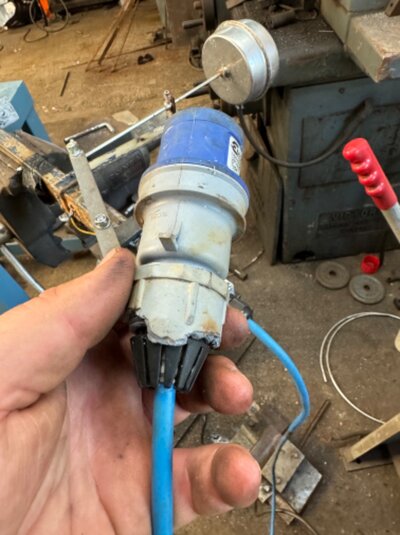
It eats plugs for fun this media. I replaced this plug with a brand new one and it done the same in under a week.
Time to hardwire into a nice stainless isolator...
Not all plugs are the same plastic either, some will likely have more resistance against certain chemicals than others.
How is the plug getting covered in flux anyway, or is it fume?
If it matters, they also do a controller with a built in alarm - https://uk.rs-online.com/web/p/level-controllers/7800292I was switching 240v ac
I'll probably order one of their controllers and a new float then
I swapped out to a sump pump type float last time, it was an expensive one...... but part of me can;t see it lasting vs the stainless float with mag switches
gaz1
Member
- Messages
- 20,515
- Location
- westyorkshire
it will be the fumes and then when the system goes cold it will turn back to a solid acid flux state with each cycleHow is the plug getting covered in flux anyway, or is it fume?
im wondering if a fill up timer might be better where the materials are pumped into the mix and will shut off the fill up valve by a timed circuit instead

Brad93
Member
- Messages
- 19,416
- Location
- Essex, United Kingdom
Its not fumesit will be the fumes and then when the system goes cold it will turn back to a solid acid flux state with each cycle
im wondering if a fill up timer might be better where the materials are pumped into the mix and will shut off the fill up valve by a timed circuit instead
Brad93
Member
- Messages
- 19,416
- Location
- Essex, United Kingdom
The machine is not very good, flux gets spilt everywhere during the filling cycle and during the cleaning process.Time to hardwire into a nice stainless isolator...
Not all plugs are the same plastic either, some will likely have more resistance against certain chemicals than others.
How is the plug getting covered in flux anyway, or is it fume?
As i mentioned the staff are, how to put it, of a very basic skillset.
Amazing they are allowed to play with 96% Red Sulphuric and neat HCL really.
- Messages
- 13,576
- Location
- England
Sounds like it's time to invest in a bit of kit that works better...safer, extraction
It meets all the latest PUWER regs no doubt
It meets all the latest PUWER regs no doubt
The machine is not very good, flux gets spilt everywhere during the filling cycle and during the cleaning process.
As i mentioned the staff are, how to put it, of a very basic skillset.
Amazing they are allowed to play with 96% Red Sulphuric and neat HCL really.


addjunkie
Member
- Messages
- 14,290
- Location
- Northumberland. Reet oot in the sticks
Id suggest @Brad93 backs away from this. I cant imagine designing safety instrumented systems is a subject covered while training as a Welder. So much so that if you engineer something, and it goes pete tong, and an employee gets hurt/ burnt etc @Parm pals back at the HSE may have a field day in-front off a man in a grey wig.Sounds like it's time to invest in a bit of kit that works better...safer, extraction
It meets all the latest PUWER regs no doubt
Id suggest nucleonics from Tracerco, but doubt there is a big enough budget.