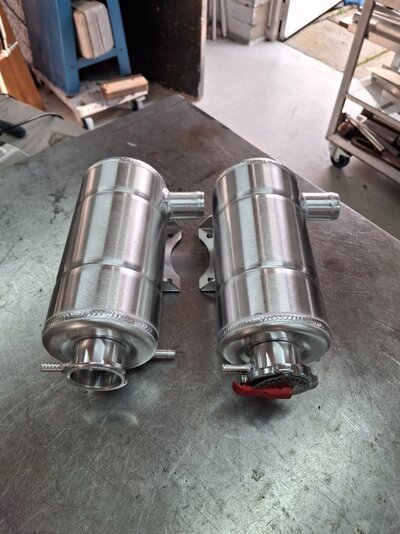
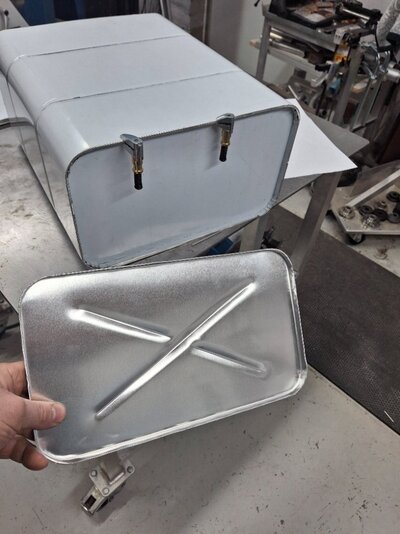
Whats the consensus on Fuel tank ends like these i made a buck and formed the ends over it, I've been thinking of making some like this, ill need better hammers etc, seems really strong and ridgid, what's the pros and cons

You are using an out of date browser. It may not display this or other websites correctly.
You should upgrade or use an alternative browser.
You should upgrade or use an alternative browser.
Fuel tank ends
- Thread starter Cheesie
- Start date

Wedg1e
They call me Mr. Bodge-angles
- Messages
- 7,921
- Location
- Teesside, England
It's a standard way of making tanks, but you'll have your work cut out vs. stamping and pressing.
My TVR (and the Lotus I had) tanks are made that way; the seam was resistance welded (you can see the marks left by the rollers), there was some local touch-up soldering as well... but I'm sure MIG or TIG would work just the same.
The TVR tanks are made from galvanised sheet, might be an option although the fumes are nasty.
Some waffle on my webbie about a repair I did several years ago, you can see the track marks from the resistance welder:
My TVR (and the Lotus I had) tanks are made that way; the seam was resistance welded (you can see the marks left by the rollers), there was some local touch-up soldering as well... but I'm sure MIG or TIG would work just the same.
The TVR tanks are made from galvanised sheet, might be an option although the fumes are nasty.
Some waffle on my webbie about a repair I did several years ago, you can see the track marks from the resistance welder:
My bike pannier bottoms are formed like that without the stiffening X. Never been a problem in 12 years.
Last motorbike tank base was welded on to that design, it was 30 years old without leaking.
Fold the straights in the press, anneal the corners and then beat over the former to make the corners.
Last motorbike tank base was welded on to that design, it was 30 years old without leaking.
Fold the straights in the press, anneal the corners and then beat over the former to make the corners.


BrokenBiker
Member
- Messages
- 12,673
- Location
- Newport, South Wales
After playing with my bead roller for a bit I'd be confident that it could produce that, me not so much just yet as I don't have a tipping die, but the equipment is more than up to it

Morris
Forum Supporter
- Messages
- 2,138
- Location
- Northamptonshire.
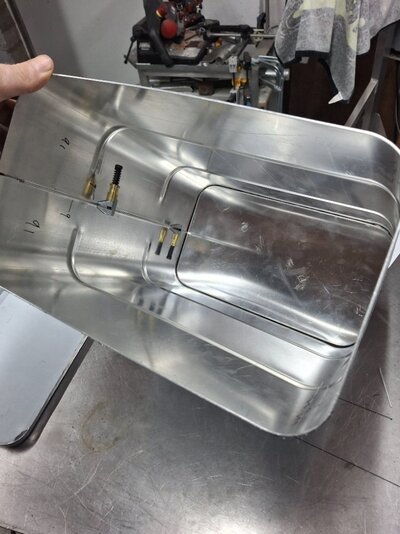
It's baffled John, also has a built-in swirl pot.You putting baffles in ? You too Paul ?
Bead roller is a little iffy for getting the exact same form, for me anyway, with a former and the edges beat over i get the same result each time, as for the stiffner cross in the middle of the end tank i may go a different road for them, the former ideally needs a bit of steel plate same size fixed to the wood, this is a self learning process, I think I'll get myself some panel beating/plannishing hammersI thought you had a bead roller ,,, thats the way to go , if its heavy enough to handle the thickness your using
Question is even though a lot of old tanks where made this way, I've been told by a friend he fixed a few of tanks made this way in his old place of work, personally it looks to be a superior way of making them with added stiffnessI'm not sure if there's a question in the OP post, it looks great to me, normal way to do it. Here's my effort in stainless.
View attachment 525413
Any photos of the internal swirl pot/catchment area, ive looked at a few designs on the internet but I've never done one myself except with expensive one way valvesIt's baffled John, also has a built-in swirl pot.
try an air hammer and flow form them ,,, as for planishing hammers , just polish the end of a 1 lb ball pein , it will probably do what you want to start with ,,, Ive a few hammers and seem to only ever use about four of themBead roller is a little iffy for getting the exact same form, for me anyway, with a former and the edges beat over i get the same result each time, as for the stiffner cross in the middle of the end tank i may go a different road for them, the former ideally needs a bit of steel plate same size fixed to the wood, this is a self learning process, I think I'll get myself some panel beating/plannishing hammers
Morris
Forum Supporter
- Messages
- 2,138
- Location
- Northamptonshire.
Unfortunately not. It was made from part of a stainless steel flask I found in a charity shop. It forms a small sump lower than the floor of the tank and houses a pump from CBS, apparently a jaguar part. The return from the fuel rail goes into the lowest part of the swirl pot and sits in a venturi tube.Any photos of the internal swirl pot/catchment area, ive looked at a few designs on the internet but I've never done one myself except with expensive one way valves
Thats what I used, an air hammer is on the things to purchase listtry an air hammer and flow form them ,,, as for planishing hammers , just polish the end of a 1 lb ball pein , it will probably do what you want to start with ,,, Ive a few hammers and seem to only ever use about four of them
you will need two ,, a brutal hard hitter ,,, and a nice handy finisher ,,, its just how they seem to be ,,Thats what I used, an air hammer is on the things to purchase list
you didnt really think one would do
one never does
more is not always better
its
just
always more.


sako243
Member
- Messages
- 4,363
- Location
- My mansion in Wales
@Cheesie are they always the same or are you adapting the size / shape for each one?
If the former a friend up in Scotland had good success in making some press tooling for pressing the bulkhead vents for a Lightweight Land Rover in aluminium. He was lucky he could get 80mm thick offcuts from the scrap bin at work for free but he essentially milled out the formers and then shoved them in his hydraulic press.
If they're not a common size then becomes rather expensive way of doing it though.
If the former a friend up in Scotland had good success in making some press tooling for pressing the bulkhead vents for a Lightweight Land Rover in aluminium. He was lucky he could get 80mm thick offcuts from the scrap bin at work for free but he essentially milled out the formers and then shoved them in his hydraulic press.
If they're not a common size then becomes rather expensive way of doing it though.
It this in aluminium?
Depends on how many you are doing but this might work.
Make a former out of good quality 18mm or thicker plywood.
Run a router round one edge to leave it slightly curved.
Set your annealed sheet of ally on it, place another sheet of ply on top and clamp it all together.
Go round the edges and hammer them round the former.
Thicker ply would be better but is expensive. You could reinforce the ply by gluing on offcuts of kitchen worktop.
Depends on how many you are doing but this might work.
Make a former out of good quality 18mm or thicker plywood.
Run a router round one edge to leave it slightly curved.
Set your annealed sheet of ally on it, place another sheet of ply on top and clamp it all together.
Go round the edges and hammer them round the former.
Thicker ply would be better but is expensive. You could reinforce the ply by gluing on offcuts of kitchen worktop.
Thats how I done them, wood is too soft so im going to cut some steel to screw onto the bottom former 4-6mm should do, i plan to cut an x in the steel and form it with an air hammer,It this in aluminium?
Depends on how many you are doing but this might work.
Make a former out of good quality 18mm or thicker plywood.
Run a router round one edge to leave it slightly curved.
Set your annealed sheet of ally on it, place another sheet of ply on top and clamp it all together.
Go round the edges and hammer them round the former.
Thicker ply would be better but is expensive. You could reinforce the ply by gluing on offcuts of kitchen worktop.
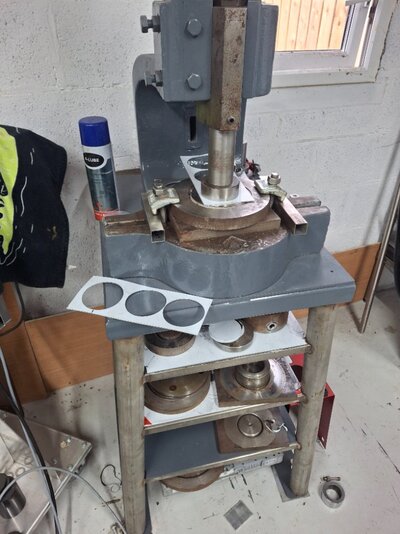
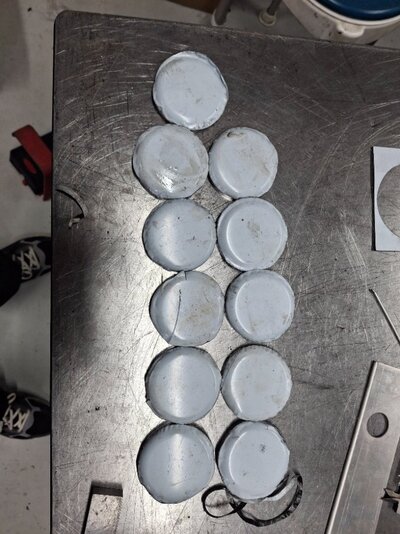
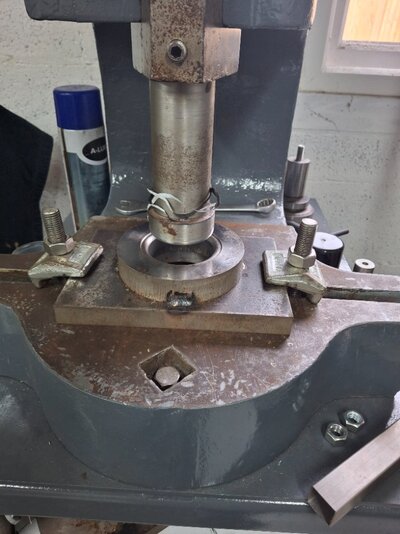
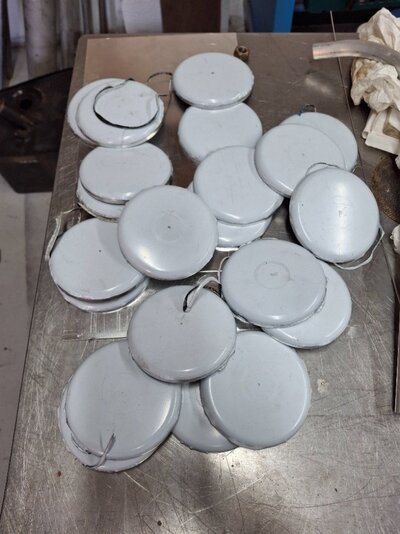
I use this method on smaller tanks but these are quite large and would struggle in my fly press, the end plan is to have some cut at different sizes, them its only the length of tank that changes, I've gathering a few different tanks from older cars to copy, smaller tanks I use the method above on pressing tank ends@Cheesie are they always the same or are you adapting the size / shape for each one?
If the former a friend up in Scotland had good success in making some press tooling for pressing the bulkhead vents for a Lightweight Land Rover in aluminium. He was lucky he could get 80mm thick offcuts from the scrap bin at work for free but he essentially milled out the formers and then shoved them in his hydraulic press.
If they're not a common size then becomes rather expensive way of doing it though.
I use this method on smaller tanks but these are quite large and would struggle in my fly press, the end plan is to have some cut at different sizes, them its only the length of tank that changes, I've gathering a few different tanks from older cars to copy, smaller tanks I use the method above on pressing tank@Cheesie are they always the same or are you adapting the size / shape for each one?
If the former a friend up in Scotland had good success in making some press tooling for pressing the bulkhead vents for a Lightweight Land Rover in aluminium. He was lucky he could get 80mm thick offcuts from the scrap bin at work for free but he essentially milled out the formers and then shoved them in his hydraulic press.
If they're not a common size then becomes rather expensive way of doing it though.