



You are using an out of date browser. It may not display this or other websites correctly.
You should upgrade or use an alternative browser.
You should upgrade or use an alternative browser.
Any Dellorto DHLA 45 Guru's on Here?
- Thread starter Dilkris
- Start date

It may be that under your test conditions the engine is not sucking in the air fast enough to carry the fuel in.if I "blip" the throttle - it seems the accelerator pumps inject too much volume of fuel.
I'd get the car assembled and take it to rolling road.

colnerov
Member
- Messages
- 5,128
- Location
- Nr Gatwick UK
Many thanks your reply.
Please see photo's of said screws in my original post - there is no through drilling as I expected. Have poked around with nozzle cleaners. I equally expected them to function as per your description - they don't.
I agree re vacuum balancer - but reluctant to spend £50 for something I will use for 5 minutes just once...
This project over the years has hemorrhaged money
BIB. I see you're hopeful that they are going to stay in tune for an extended period.


On Webers there is bleedback jet so that not all the fuel is squirted in - effectively you can play with the stroke of the pump, the bleedback, and the actual squirty jet - gives a good range of adjustability. Not really played with Dellortos, although I do have a single 45 here.Yes - the accelerator pump mechanism is an arrangement as you describe - and yes it would be adjustable as you equally surmise.
Yes - fuel drips out of the inlet trumpets if I "blip" the throttle - it seems the accelerator pumps inject too much volume of fuel.
At idle, with the accelerator pumps not operable and dormant so to speak - all is good.
I would be checking the various jet sizes, you need only squirt in just enough, otherwise bore wash and even a fire car be the result. And yes, a filter or fuel king regulator is a must if you have more than 3 psi of fuel pressure.


northwest
Searching for the Holy Grail.........
- Messages
- 6,859
- Location
- Manchester UK
Agreed - if I had a money tree I would consider it
Oh I don't know built my last set on a right budget, the ally fuel rail came from a table leg and the butterflies were four individual strombergs (I think) chopped and welded. The inlet manifold I modified too to give me a straighter, cleaner shot to the back of the inlet valves (not welded by me may I add, this was in the days of "argon arc").
Management was an Emerald M3D system but there are plenty to choose from nowadays.
tommy dunlop
Member
- Messages
- 253
To much information
tommy dunlop
Member
- Messages
- 253
That's a fair comment - but I doubt if the car will do more than 2,000 miles/year when complete - if that.BIB. I see you're hopeful that they are going to stay in tune for an extended period.

Be aware that back in the day floats needed 3psi if fed direct with no return pipe.
5psi was for motors with a reduced diameter fuel return tube back to the tank.
You can make a manometer from a random 3ft piece of wood, 6ft+ of windscreen washer tubing, some cable cleats, a trysquare and some water. Mark the wood across every inch cleat the tube in a U leaving one end long enough to attach to the carb. Fill the tube a 1/4 full. Most readings at tick over will be OK. Blip the throttle and the tube will emptied very quickly. Hopefully you wont need mercury.
5psi was for motors with a reduced diameter fuel return tube back to the tank.
You can make a manometer from a random 3ft piece of wood, 6ft+ of windscreen washer tubing, some cable cleats, a trysquare and some water. Mark the wood across every inch cleat the tube in a U leaving one end long enough to attach to the carb. Fill the tube a 1/4 full. Most readings at tick over will be OK. Blip the throttle and the tube will emptied very quickly. Hopefully you wont need mercury.
OK - thought I'd close this thread by hopefully embracing all the helpful comments and telling you all what I did. First of all:-
"Yes" - if I had a money tree I would convert to throttle bodies and fuel injection - kits are widely sold for these engines, (as they are still extensively used in some motorsport classes) - but the cost is some £2500 plus VAT. For me that is a none starter and rightly or wrongly, originality is important to me.
Measuring the fuel pressure gave me a 3 psi reading and a multitude of sources advised that this was well within operational limits for Dellorto DHLA Carbs.
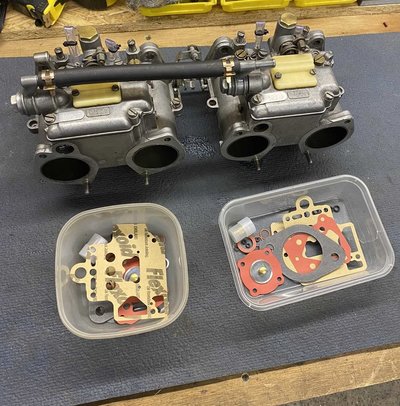
I did replace the accelerator pump diaphragms and float bowl needles and seats, (See photo)
The size of the carbs is interesting, (some thought DHLA 45's were overly large for a 1600 cc engine) - whilst the carburetor barrels are 45mm, they have auxiliary venturis which are 40mm - these match the inlet ports on the head of the engine which are equally 40mm.
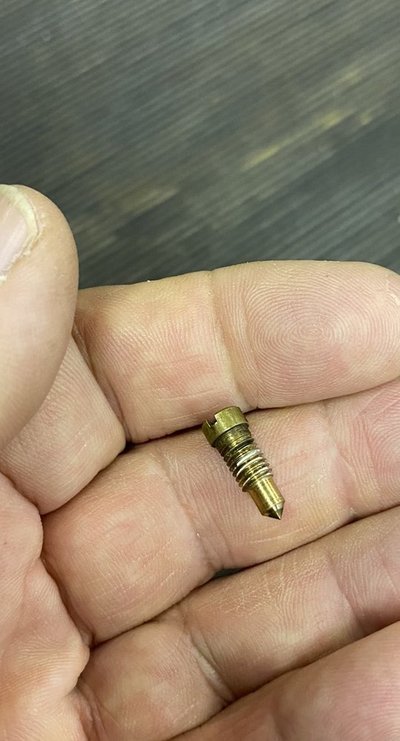
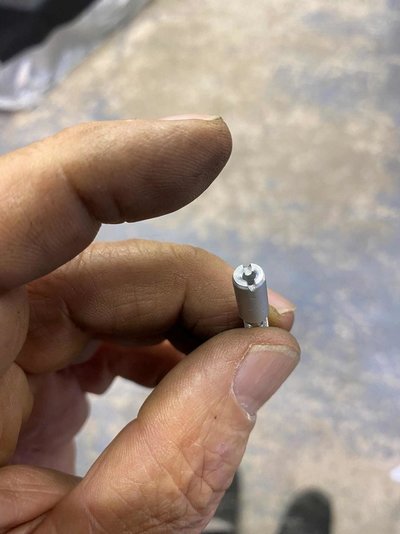
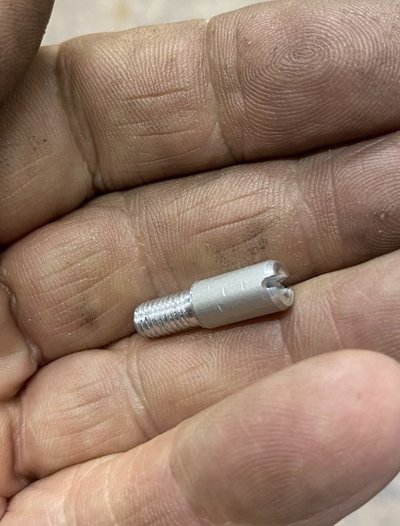
The vacuum points which appear to be "openable" are in point of fact plugs and I machined 4 off vacuum attachments (see photos)
Regarding balancing I made up a manometric affair using 3 in 1 oil, some tubing and some simple throttling valves (see photo's) - this proved to be highly effective - and cheap..... I first balanced carb to carb, (as the throttle spindles are common to both butterflies), and then balanced butterfly to butterfly on the same carb using the air bypass screws. It was quite a mission and a learning curve, I had to experiment with various liquids and the in line throttling valves to slow down so to speak the reaction of the vacuums.
Finally I re-adjusted the volume of fuel injected by the accelerator pumps, per stroke, (they were over fueling) and last of all played with the idle mixture screws to find the sweet spot on each carb.
I then repeated the whole balancing process.....
All is good and the engine sounds happy.
Many thanks again for everyone that "chipped in" - without your collective input and comments - I would still be at a standstill.
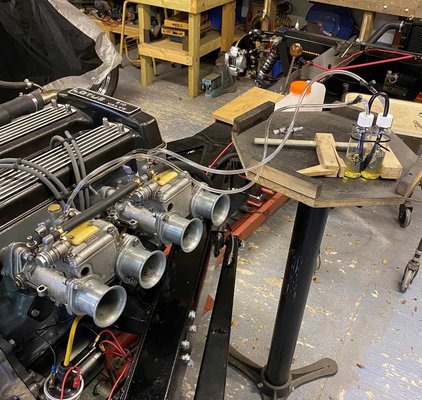
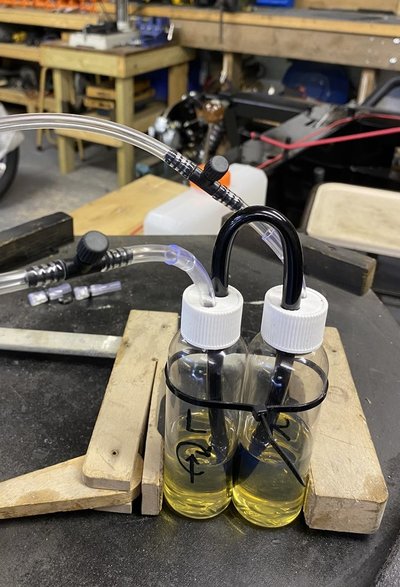
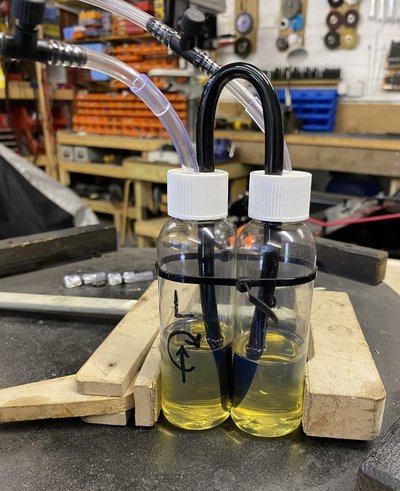
"Yes" - if I had a money tree I would convert to throttle bodies and fuel injection - kits are widely sold for these engines, (as they are still extensively used in some motorsport classes) - but the cost is some £2500 plus VAT. For me that is a none starter and rightly or wrongly, originality is important to me.
Measuring the fuel pressure gave me a 3 psi reading and a multitude of sources advised that this was well within operational limits for Dellorto DHLA Carbs.
I did replace the accelerator pump diaphragms and float bowl needles and seats, (See photo)
The size of the carbs is interesting, (some thought DHLA 45's were overly large for a 1600 cc engine) - whilst the carburetor barrels are 45mm, they have auxiliary venturis which are 40mm - these match the inlet ports on the head of the engine which are equally 40mm.
The vacuum points which appear to be "openable" are in point of fact plugs and I machined 4 off vacuum attachments (see photos)
Regarding balancing I made up a manometric affair using 3 in 1 oil, some tubing and some simple throttling valves (see photo's) - this proved to be highly effective - and cheap....
. I first balanced carb to carb, (as the throttle spindles are common to both butterflies), and then balanced butterfly to butterfly on the same carb using the air bypass screws. It was quite a mission and a learning curve, I had to experiment with various liquids and the in line throttling valves to slow down so to speak the reaction of the vacuums. Finally I re-adjusted the volume of fuel injected by the accelerator pumps, per stroke, (they were over fueling) and last of all played with the idle mixture screws to find the sweet spot on each carb.
I then repeated the whole balancing process.....
All is good and the engine sounds happy.
Many thanks again for everyone that "chipped in" - without your collective input and comments - I would still be at a standstill.

Nomad
Member
- Messages
- 2,399
- Location
- North Devon (for how long?)
Very neat, I love the "specimen jars" for the fluids.
From a technical point I don't think the system needs to be a closed loop, I've not opened my set of 4 gauges up but I think they operate as 4 individual gauges all with open vents to atmosphere. Doing it your way shows the difference between the cylinders so less chance of a large pressure difference sucking the fluid out of your gauges which has to be good news.
From a technical point I don't think the system needs to be a closed loop, I've not opened my set of 4 gauges up but I think they operate as 4 individual gauges all with open vents to atmosphere. Doing it your way shows the difference between the cylinders so less chance of a large pressure difference sucking the fluid out of your gauges which has to be good news.
I agree - but I was wanting to simply "balance" and not "measure" the vacuum.Very neat, I love the "specimen jars" for the fluids.
From a technical point I don't think the system needs to be a closed loop, I've not opened my set of 4 gauges up but I think they operate as 4 individual gauges all with open vents to atmosphere. Doing it your way shows the difference between the cylinders so less chance of a large pressure difference sucking the fluid out of your gauges which has to be good news.
I forgot to mention that I made sure the total volume of oil was slightly less than the volume of one container so sucking the contents into the inlet manifold was impossible.
I found the specimen jars on line - I had nothing suitable
I'm a fair way away from actually driving this car and due to my age I will probably have forgotten this very useful messageWhen you come to drive it the other thing worth remembering is the idle jets are in use up to about 2500rpm, made a big difference to the driveability of mine swapping them about
With the "go kart" part now pretty much complete - excepting the odd 5% outstanding - which will probably take as long as the first 95%
 I am next due to move onto the body.....