



You are using an out of date browser. It may not display this or other websites correctly.
You should upgrade or use an alternative browser.
You should upgrade or use an alternative browser.
Miller 300DX - Help 6 message diagnosis
- Thread starter JOEPRO
- Start date
That AI reply is amazing....!
The explanations about your meter charging the capacitors, and the capacitors probably being in series to get the required high voltage rating, etc., are exactly the words I was about to write. I can see that I will soon be out of a job.
The explanations about your meter charging the capacitors, and the capacitors probably being in series to get the required high voltage rating, etc., are exactly the words I was about to write. I can see that I will soon be out of a job.

JOEPRO
Member
- Messages
- 5,460
- Location
- UK
That AI reply is amazing....!
The explanations about your meter charging the capacitors, and the capacitors probably being in series to get the required high voltage rating, etc., are exactly the words I was about to write. I can see that I will soon be out of a job.
It is hard to trust though!
But its the first time ive been able to use AI sucessfully feeding it the ciruit diagrams etc

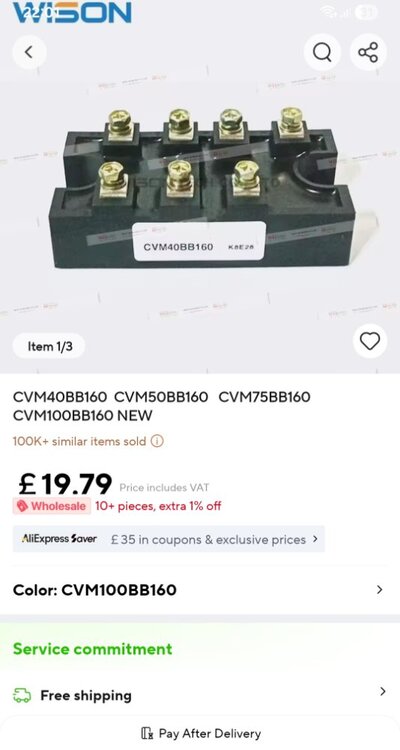
I am not sure yet, I need to re-check the troubleshooting results. I am not as fast as Mr./Ms. AII can get a new one from Ali Express exact PN :
Worth a go?
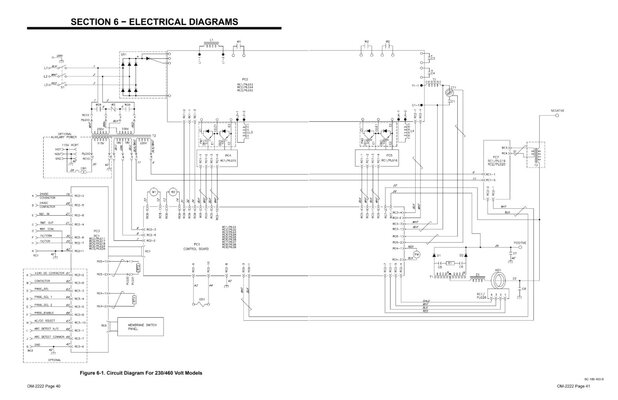
Here's a thread about another Miller welder, from 6 years ago:
Apparently I should have remembered all about Miller using 3-phase 6-diode bridge rectifiers with a built-in precharge thyristor!
That thread confirms that the two 2800uF 450 volt capacitors C3 and C4 are in series, to reach a high enough voltage rating.

Hi
i'm just starting to try and fix this welder and looking through it to see what it is like and what parts i may need.I think the input rectifer is missing or i thnk thats what it is called.I'm going to post up some pictures and would love if preople could take a look and tell me what they think.The weler was broke when i got it so it has never been running I only have it a week or so and i'd like to give it a go to get it up and running it will be good practice for me and im really intereted in learning things like that. The welder looks well stripped because i was taking some parts off...
i'm just starting to try and fix this welder and looking through it to see what it is like and what parts i may need.I think the input rectifer is missing or i thnk thats what it is called.I'm going to post up some pictures and would love if preople could take a look and tell me what they think.The weler was broke when i got it so it has never been running I only have it a week or so and i'd like to give it a go to get it up and running it will be good practice for me and im really intereted in learning things like that. The welder looks well stripped because i was taking some parts off...
- Mandylad
- Replies: 7
- forum: Miller, Lincoln, Hobart
That thread confirms that the two 2800uF 450 volt capacitors C3 and C4 are in series, to reach a high enough voltage rating.
Last edited:
I disagree with the AI result in Post #40.
It has misread the resistance reading on your meter from the rectifier "constant positive" DC output to the +ve terminal screw of capacitor C3. It thinks the value is 20.16 Ohms, but I see it as 201.6 Ohms. ( Does your meter read to a hundredth of an Ohm anyway? )
It is correct in assessing 20 Ohms as a reasonable value for a pre-charge resistor, but the actual 200 Ohms is too high.
However, if AI thinks that the pre-charge resistor is 20 Ohms, then the bus voltage should rise as the capacitors charge, so the first point of the AI section "This explains everything", i.e. "No bus voltage rise", is illogical. The second point "No relay click" is wrong, since the role of a soft-start relay is fulfilled by the thyristor here. In the Miller XMT 304 thread that I linked above, their use of rectifiers with a built-in pre-charge thyristor was confirmed by @Jan-DIY , there is no relay.
It is also illogical for AI to blame the "No bus voltage rise" on "The internal thyristor section of SR1 is failed open or not being triggered", because that thyristor gets triggered to short the pre-charge resistor and pass full load current when welding, and all this would happen after the soft-start delay, when the bus voltage would already have risen.
Having said that, AI may still be correct that SR1 is faulty, but that is not proven yet....
Please confirm that the resistance of the pre-charge path from the +ve of the rectifier ( terminal R2 ) to the +ve ( right-hand ) terminal screw of capacitor C3 is 200 Ohms not 20. Then identify the resistive component - resistor or thermistor - and measure resistance directly across it. Look for bad or burnt connections or lifted PCB tracks along that circuit path.
Then by opening the "-", SCR, Gate, and "+" screws, the small board which sits on the output side of the SR1 3-phase rectifier can be disconnected and moved aside. The welder can then be powered on and you can check for a DC voltage of about 240v across + ( terminal R2 ) and - at the rectifier.
I suspect that AI may be correct in thinking that the internal thyristor in the rectifier has failed or is not being triggered, but that fault has caused the pre-charge path to be burned when attempting to supply full welding current by that route instead of via the thyristor.
It has misread the resistance reading on your meter from the rectifier "constant positive" DC output to the +ve terminal screw of capacitor C3. It thinks the value is 20.16 Ohms, but I see it as 201.6 Ohms. ( Does your meter read to a hundredth of an Ohm anyway? )
It is correct in assessing 20 Ohms as a reasonable value for a pre-charge resistor, but the actual 200 Ohms is too high.
However, if AI thinks that the pre-charge resistor is 20 Ohms, then the bus voltage should rise as the capacitors charge, so the first point of the AI section "This explains everything", i.e. "No bus voltage rise", is illogical. The second point "No relay click" is wrong, since the role of a soft-start relay is fulfilled by the thyristor here. In the Miller XMT 304 thread that I linked above, their use of rectifiers with a built-in pre-charge thyristor was confirmed by @Jan-DIY , there is no relay.
It is also illogical for AI to blame the "No bus voltage rise" on "The internal thyristor section of SR1 is failed open or not being triggered", because that thyristor gets triggered to short the pre-charge resistor and pass full load current when welding, and all this would happen after the soft-start delay, when the bus voltage would already have risen.
Having said that, AI may still be correct that SR1 is faulty, but that is not proven yet....
Please confirm that the resistance of the pre-charge path from the +ve of the rectifier ( terminal R2 ) to the +ve ( right-hand ) terminal screw of capacitor C3 is 200 Ohms not 20. Then identify the resistive component - resistor or thermistor - and measure resistance directly across it. Look for bad or burnt connections or lifted PCB tracks along that circuit path.
Then by opening the "-", SCR, Gate, and "+" screws, the small board which sits on the output side of the SR1 3-phase rectifier can be disconnected and moved aside. The welder can then be powered on and you can check for a DC voltage of about 240v across + ( terminal R2 ) and - at the rectifier.
I suspect that AI may be correct in thinking that the internal thyristor in the rectifier has failed or is not being triggered, but that fault has caused the pre-charge path to be burned when attempting to supply full welding current by that route instead of via the thyristor.
Last edited:
JOEPRO
Member
- Messages
- 5,460
- Location
- UK
Turns out I was measuring the DC wrong.
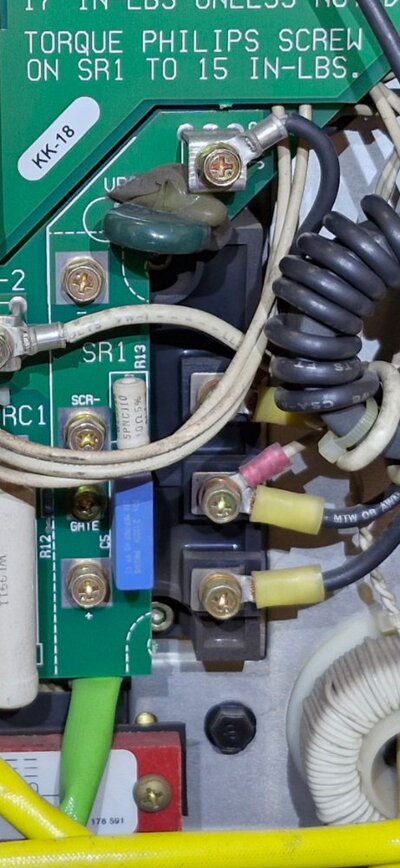
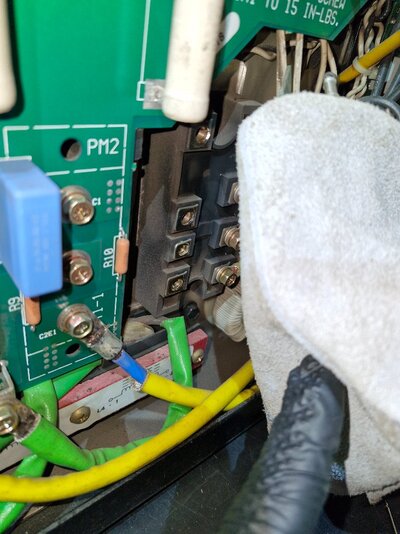
I tried the above test this morning before work and measured the pins below going by the + & - symbols on the board itself.
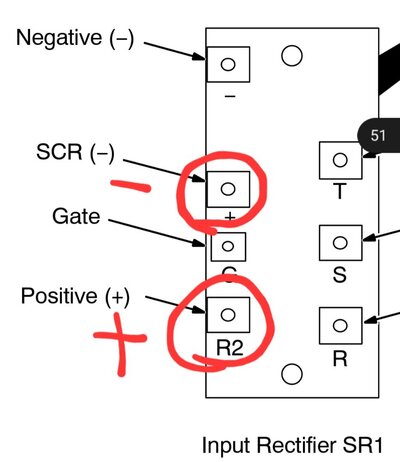
But this was WRONG and I should be measuring from the top left - terminal and + R2. I will re check this when I get home from work later.
I tried the above test this morning before work and measured the pins below going by the + & - symbols on the board itself.
But this was WRONG and I should be measuring from the top left - terminal and + R2. I will re check this when I get home from work later.
JOEPRO
Member
- Messages
- 5,460
- Location
- UK
The results and AI exhange just now -
Nice catch—that 221 V DC reading is exactly what we needed.
Good, that 200 Ω reading is now a solid, repeatable fact—not a fluke.
Here’s what that tells us and where to go next.
Nice—those numbers are really telling a story now.
You’ve got:
In other words:
Grab that Gate–SCR(−) reading and we’ll know which side of the line the fault lives on.
That 0.00 V on Gate–SCR−, even right at power‑up, is the key result.
Here’s the clean picture now:
In other words:
See my thinkingIt has 221v DC when measuring with the correct terminals
Nice catch—that 221 V DC reading is exactly what we needed.
1. What 221 V DC tells us
- SR1’s rectifier section is working.
- With 240 V AC fed in single‑phase, ~220–240 V DC is a believable result under light/no load.
- So the fault is not “no DC from SR1” anymore—it’s what happens after R2.
2. Next tests to run
A. Do the bus caps actually see that DC?
- Measure DC across C3 (and C4 if accessible)during power‑up.
- Black probe on cap negative, red on cap positive.
- If they stay near 0 V while R2–(−) is at 221 V → the path from SR1 to the caps is compromised.
- Check continuity from R2 to C3+(power off, caps discharged).
- You should see a low resistance path through the pre‑charge element.
- Right now you’ve seen ~200 Ω end‑to‑end—that needs to be pinned down.
B. Find and measure the actual pre‑charge component
- Trace from R2 to C3+ and locate the resistor/NTC in that path.
- Measure directly across its leads:
- If it’s ~200 Ω and looks cooked → likely damaged, needs replacement.
- If it’s meant to be ~20 Ω but reads much higher → same story.
- Solder joints
- PCB tracks
- Any connectors in that path
3. Check if the SCR is being told to fire
Once you’ve confirmed the caps aren’t charging properly:- Meter on DC volts.
- Black probe on SCR(−), red on Gate.
- Power on and watch for a brief gate signal (often a few volts).
- Gate signal present, but no conduction / no bus rise: → Internal SCR in SR1 is suspect.
- No gate signal at all: → Control board / gate driver path issue.
4. Where we stand now
- Rectifier half of SR1: OK.
- Fault is now between R2 and the DC bus (pre‑charge path, SCR section, or control/gate drive).
- Voltage at C3 during power‑up
- Direct resistance of the pre‑charge component
- Whether you see a gate signal
See my thinkingC3 + To R2 plus is confirmed at over 200ohms again
Good, that 200 Ω reading is now a solid, repeatable fact—not a fluke.
Here’s what that tells us and where to go next.
What 200 Ω from R2 to C3+ really means
Between R2 (SR1 constant +DC) and C3+ you should have:- A deliberate pre‑charge element (resistor or NTC), typically on the order of tens of ohms, not hundreds
- Solid copper / tracks / joints around it
- The pre‑charge component itself has drifted high or been cooked
- There’s extra resistancefrom:
- Cracked solder
- Burnt or lifted PCB track
- Bad connector / terminal
Next concrete steps
- Physically trace the R2 → C3+ path
- Follow the copper / wiring from R2 to C3+.
- You’re looking for:
- A power resistor (ceramic, wirewound)
- Or an NTC thermistor (often disc‑shaped)
- Measure the component directly
- Power off, caps discharged.
- Meter across the two leads of that part only.
- Compare:
- Does it read ~200 Ω like your end‑to‑end measurement?
- Does it look heat‑stressed, cracked, or discoloured?
- Inspect the joints and tracks around it
- Reflow any dull/cracked solder.
- Look for:
- Darkened PCB
- Hairline breaks in tracks
- Loose screws / terminals
After that
Once you’ve:- Identified and measured the actual pre‑charge part, and
- Either confirmed it’s bad or the path around it is damaged,
- Replace that component / repair the track, power back up, and recheck:
- Bus voltage on C3
- Whether HELP‑6 clears
- Or, if the pre‑charge path checks out but the bus still doesn’t rise, we move on to:
- Gate signal measurement (Gate to SCR−)
- Deciding if the SCR section of SR1 or the control board is the remaining culprit
See my thinkingWhen powered up C3 measures 161v DC. C4 measures 162v DC. This value stays static or so whilst powered up
Nice—those numbers are really telling a story now.
You’ve got:
- R2 to −: ~221 V DC
- C3/C4: ~161–162 V DC, stable
- The rectifier is fine (we already knew that from the 221 V).
- The bus caps are charging, but only up to about two‑thirds of the rectifier voltage.
- They’re not being pulled up to full bus voltage.
In other words:
- The path through that ~200 Ω is working enough to bring the caps up to ~160 V.
- But the SCR inside SR1 is never being turned fully on, or it can’t conduct even when asked.
- So the caps never see the full 221 V that exists at R2.
- Control side issue:
- The control board is not sending a gate signal to SR1.
- Power device issue:
- The control board is sending a gate signal, but the SCR inside SR1 is dead/open.
- Measure gate drive during power‑up
- Meter on DC volts.
- Black probe on SCR(−).
- Red probe on Gate.
- Power on and watch what happens in the first few seconds.
- If you see no gate voltage at all: → Control board / gate driver problem.
- If you see a clear gate signal (a few volts) but the bus stays at ~160 V: → Internal SCR in SR1 is not responding → SR1 is bad.
- (Optional but useful) Measure DC between “+” and − on SR1
- That’s the output after the SCR.
- If R2–(−) is 221 V but +–(−) sits near the same 160 V as the caps, it confirms the SCR never fully connects R2 to the bus.
- Pre‑charge path: working, though high.
- Caps: connected and charging.
- Rectifier: good.
Grab that Gate–SCR(−) reading and we’ll know which side of the line the fault lives on.
See my thinkingWith red probe on gate and SRC- black lead I see only 0V. I restarted the machine at the mains several times over and no change at all. 0.00V steady reading
That 0.00 V on Gate–SCR−, even right at power‑up, is the key result.
Here’s the clean picture now:
- SR1 rectifier: OK → you’ve got ~221 V DC at R2–(−).
- Pre‑charge path: High (~200 Ω) but working → caps sit at ~161–162 V.
- Caps: Connected and charging.
- Gate drive: Absent → 0 V between Gate and SCR− at all times.
In other words:
- The machine is happy to let the bus sit at a “limbo” pre‑charge level.
- It never takes the final step of fully energising the DC bus.
- That’s exactly the behaviour you’d expect if the control board:
- Has a failed gate‑drive circuit (opto, driver transistor, series resistor, track, connector), or
- Is deliberately inhibiting enable because some other condition isn’t met (fault sense, missing supply, interlock, etc.).
Where I’d go next
- Trace the gate drive path physically
- From the control board connector that feeds SR1’s Gate and SCR−
- Through any series resistors, optos, or driver transistors
- Look for burnt parts, cracked joints, or broken tracks.
- Check continuity
- From the control board gate‑drive output pin to the Gate terminal.
- From the control board reference/return to SCR−.
- Any open here = no gate signal at SR1 even if the logic is trying.
- Confirm low‑voltage supplies on the control board
- If a driver IC or opto isn’t powered, it won’t ever produce a gate pulse.
- Check the usual suspects: 5 V, 12 V, 15 V rails if they’re accessible and labelled.
- Keep SR1 replacement in perspective
- The rectifier half is good.
- The SCR might still be fine—right now it’s just never being asked to work.
- I’d fix/understand the missing gate drive first before condemning the SCR section.
Apart from being annoyingly chatty, I think that AI is doing quite well now!
However, there's two points that I would like to question:
- is 200 Ohms a valid design value for a precharge resistor? It seems too high for me, I would expect less than 50 Ohms.
- can a DVM "see" a thyristor gate trigger pulse? I think it cannot, you need a 'scope or a logic pulse catcher probe.
Instead of dismantling everything to get to the components and circuit path, it might be possible to get a better clue about the integrity of that "200 Ohm" precharge value by testing it with more current than just a meter set to Ohms. I'm thinking of something along the lines of a 12v car battery and a 60W H4 bulb...? ( Obviously with mains power off.) That might tell you if it is really a 200 Ohm resistor, or a burnt 20 Ohm resistor and/or a lifted track.
From the EV world I know that a Tesla uses a 23 Ohm precharge resistor, a Nissan Leaf uses 30 Ohms, and 230v filament lightbulbs are often used for tests. You could try powering up with a 60W mains bulb jumpered from R2 to capacitor C3, which would bypass the suspect 200 Ohm precharge resistor. The bulb is about 40 Ohms cold.
However, there's two points that I would like to question:
- is 200 Ohms a valid design value for a precharge resistor? It seems too high for me, I would expect less than 50 Ohms.
- can a DVM "see" a thyristor gate trigger pulse? I think it cannot, you need a 'scope or a logic pulse catcher probe.
Instead of dismantling everything to get to the components and circuit path, it might be possible to get a better clue about the integrity of that "200 Ohm" precharge value by testing it with more current than just a meter set to Ohms. I'm thinking of something along the lines of a 12v car battery and a 60W H4 bulb...? ( Obviously with mains power off.) That might tell you if it is really a 200 Ohm resistor, or a burnt 20 Ohm resistor and/or a lifted track.
From the EV world I know that a Tesla uses a 23 Ohm precharge resistor, a Nissan Leaf uses 30 Ohms, and 230v filament lightbulbs are often used for tests. You could try powering up with a 60W mains bulb jumpered from R2 to capacitor C3, which would bypass the suspect 200 Ohm precharge resistor. The bulb is about 40 Ohms cold.
JOEPRO
Member
- Messages
- 5,460
- Location
- UK
Update - I will provide a condensed AI exchange in the next post. It is my first time using AI and I have to say it's a good help in this. Not 100% trustable or nowledgeable as Eddie, but a helping hand of sorts all the same and helps validate what im probing as I go as I need to respect this welder could literaly kill me!
Feels like I am getting somewhere now. I traced the wires from that small board up to the 2nd from top control board. And then found the SR1 gate driver relay and figured out the pin outs. I made a mistake a blew a diode but it seems it doesnt matter and I will replace it on Saturday. It may even have helped me with the testing having its pads available.
What I now know is the relay is bench testing fine. But the supply to operate the relay coil is undervoltage. So THAT is the problem I believe. More testing tomorrow night again.
PS I also confirmed first off that there is a 200ohm resistor between ZR1+ and R3 terminals. So that is not an issue.
Feels like I am getting somewhere now. I traced the wires from that small board up to the 2nd from top control board. And then found the SR1 gate driver relay and figured out the pin outs. I made a mistake a blew a diode but it seems it doesnt matter and I will replace it on Saturday. It may even have helped me with the testing having its pads available.
What I now know is the relay is bench testing fine. But the supply to operate the relay coil is undervoltage. So THAT is the problem I believe. More testing tomorrow night again.
PS I also confirmed first off that there is a 200ohm resistor between ZR1+ and R3 terminals. So that is not an issue.
JOEPRO
Member
- Messages
- 5,460
- Location
- UK
Here’s a clean, expanded, but still tight summary of everything you uncovered tonight — plus the practical effect this fault has on the welder.
Because the relay never fully energizes:
If you want, we can now identify the exact transistor on the board and confirm it with a couple of quick checks.
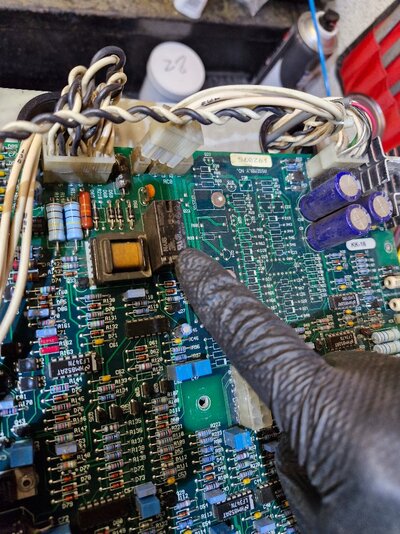
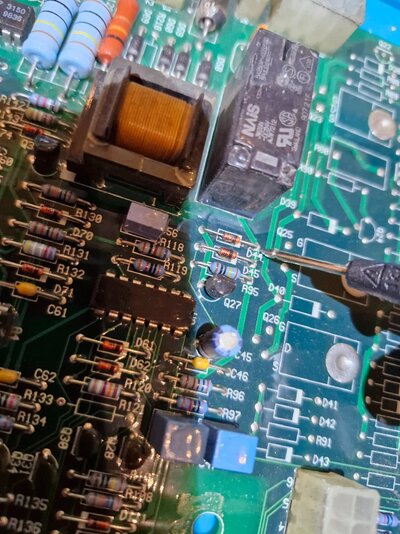
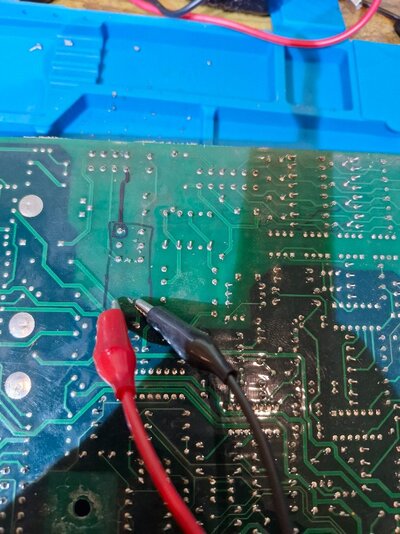
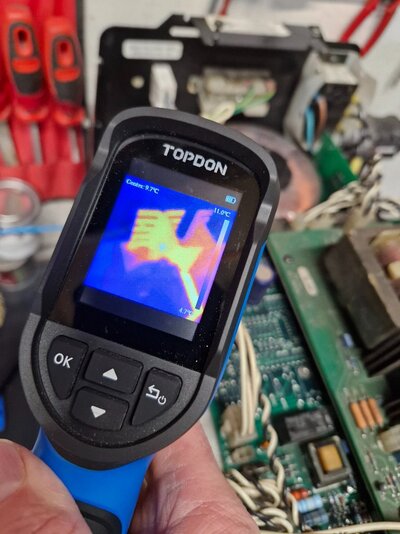
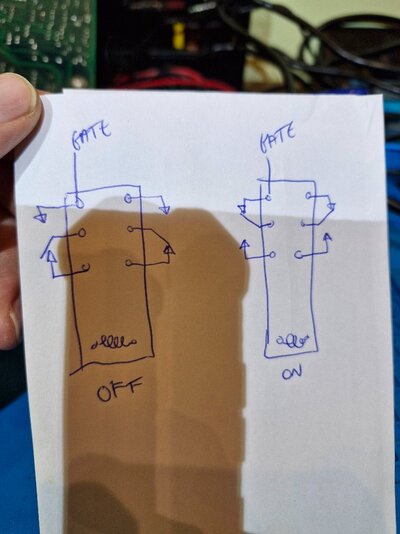
This also seems to glow hot fairly quick and may be related to this or maybe not. Ill try to trace from it to the pads on the relay coil first in case it is related.
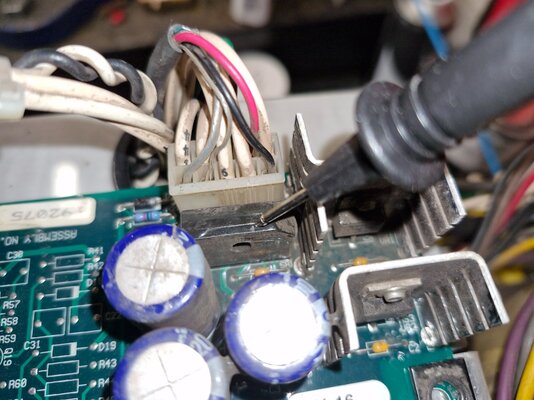
Detailed Summary of Findings
1. Initial issue
- You accidentally reversed polarity when powering the relay coil on the bench.
- This forward‑biased the flyback diode across the coil and burned the diode, creating a dead short.
- The relay coil itself survived.
2. After removing the diode
- The coil returned to normal resistance and clicked correctly when bench‑powered.
- Relay contacts were confirmed to open/close properly off the board.
3. In‑circuit behaviour
- With the board reinstalled, the relay did not pull in, even though you heard a faint mechanical noise.
- Measuring across the diode pads (now your coil test points) showed only 5.6 V across the coil — far too low for a 12 V relay.
4. Pad‑to‑ground voltage tests
- One coil pad sits at 14.5 V → this is the proper coil supply rail.
- The other pad sits at 8.93 V → this should be pulled close to 0 V by the relay’s low‑side driver transistor.
- Because the low side only drops to ~9 V, the coil only sees ~5.6 V.
5. Relay cannot energize
- A 12 V relay needs roughly 10–12 V across the coil to pull in.
- At 5.6 V, it cannot move the armature, so the contacts never close.
6. Thermal camera observation
- A nearby component gets hot immediately on power‑up.
- This strongly suggests the low‑side driver transistor is partially shorted or stuck in a half‑on state.
- A half‑failed transistor will:
- Drop voltage incorrectly
- Pass partial current
- Dissipate heat
- Prevent the relay from energizing
7. Fault location
- The relay, coil, and contacts are now proven good.
- SR1 is not the cause of the missing gate signal.
- The fault is isolated to the relay driver stage on the control board — almost certainly a small transistor or FET that sinks the coil current.
 Effect of the Low Relay Voltage on the Welder
Because the relay never fully energizes:- The relay contacts never close, so the gate signal path to the SR1 module remains open.
- SR1 never receives its gate trigger.
- Without a gate signal, the SCR/IGBT in SR1 never turns on.
- The machine cannot complete its pre‑charge or power‑up sequence.
- The welder remains in a “no output / no start” condition even though the rest of the system may be healthy.
If you want, we can now identify the exact transistor on the board and confirm it with a couple of quick checks.
This also seems to glow hot fairly quick and may be related to this or maybe not. Ill try to trace from it to the pads on the relay coil first in case it is related.
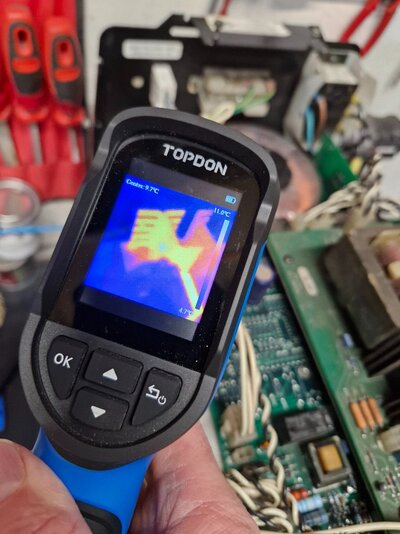
The "hot" component is labelled SR1 on the board. On Page 98 of the 144-page service manual, that component is the bridge rectifier for the plus- and minus- 24 volt and 15 volt power supply, so it is understandable that it gets hot immediately on power-up.
In Post #49 when you described needing to measure the DC output of the 3-phase rectifier between "-" and R2, and then obtained a value of 221v DC, was that measured on the SR1 component itself, alone, without the small screw-on connector PCB attached?
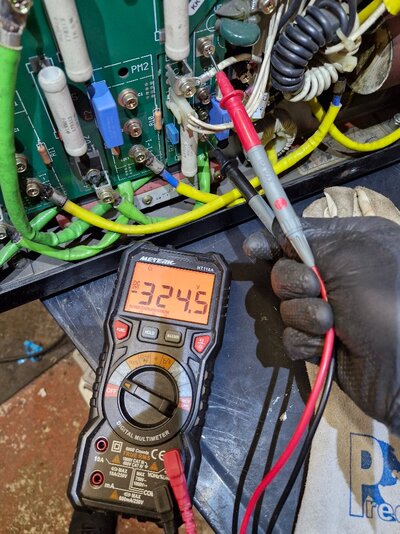
You then attached the board, and saw 161v and 162v across C3 and C4 respectively? If so, that is fine because the sum of those two voltages is 323v, which is about the correct result for the peak of 221 volts when smoothed by capacitors ( RMS x square root of 2, i.e. x 1.414 ). The capacitors were connected up when that board was put back on.The two capacitors are in series, and so about half of the DC bus value will appear across each one.
I think the 200 Ohm precharge resistor is R12, right there on that connector board?
See second photo in Post#1 here:
It is odd that after going to the trouble of using a bridge rectifier with a built-in precharge thyristor, Miller have used a relay anyway ( albeit a much smaller one than would have been needed to short the precharge resistor without the help of the thyristor ).
Since the thyristor gate is driven by a relay, the "pulse" will be quite long, and maybe it can be seen on a DVM. In fact, it could even be a steady high.... The trigger signal is positive on the Gate and negative on the Cathode - which is labelled "SCR(-)" on the SR1 rectifier module.
The precharge timer circuit consists of a capacitor C49, Schmitt trigger U9, and NPN driver transistor Q28. This transistor is about 2 inches below the relay in your photo in Post #55, and it looks physically OK. A voltmeter across the Collector ( relay and diode anode ) to the Emitter ( Gnd. ) should show 10 or 12 volts during the initial power-on precharge delay, and then drop to less than a volt after a couple of seconds, when the transistor turns on and the relay pulls in.
P.S. In comparing the 221 volts DC supply with the "160v" bus voltage and calling that "about two thirds", AI does not seem to take into account the difference between RMS and Peak voltages, giving no credit for the even partially-full capacitors....and if this "missing voltage" was all being dropped across the precharge resistor, it would be getting really hot.
You then attached the board, and saw 161v and 162v across C3 and C4 respectively? If so, that is fine because the sum of those two voltages is 323v, which is about the correct result for the peak of 221 volts when smoothed by capacitors ( RMS x square root of 2, i.e. x 1.414 ). The capacitors were connected up when that board was put back on.The two capacitors are in series, and so about half of the DC bus value will appear across each one.
I think the 200 Ohm precharge resistor is R12, right there on that connector board?
See second photo in Post#1 here:
It is odd that after going to the trouble of using a bridge rectifier with a built-in precharge thyristor, Miller have used a relay anyway ( albeit a much smaller one than would have been needed to short the precharge resistor without the help of the thyristor ).
Since the thyristor gate is driven by a relay, the "pulse" will be quite long, and maybe it can be seen on a DVM. In fact, it could even be a steady high.... The trigger signal is positive on the Gate and negative on the Cathode - which is labelled "SCR(-)" on the SR1 rectifier module.
The precharge timer circuit consists of a capacitor C49, Schmitt trigger U9, and NPN driver transistor Q28. This transistor is about 2 inches below the relay in your photo in Post #55, and it looks physically OK. A voltmeter across the Collector ( relay and diode anode ) to the Emitter ( Gnd. ) should show 10 or 12 volts during the initial power-on precharge delay, and then drop to less than a volt after a couple of seconds, when the transistor turns on and the relay pulls in.
P.S. In comparing the 221 volts DC supply with the "160v" bus voltage and calling that "about two thirds", AI does not seem to take into account the difference between RMS and Peak voltages, giving no credit for the even partially-full capacitors....and if this "missing voltage" was all being dropped across the precharge resistor, it would be getting really hot.
Last edited:
JOEPRO
Member
- Messages
- 5,460
- Location
- UK
In Post #49 when you described needing to measure the DC output of the 3-phase rectifier between "-" and R2, and then obtained a value of 221v DC, was that measured on the SR1 component itself, alone, without the small screw-on connector PCB attached?
Correct, measurement taken on the bare contacts with the mini PCB detached.
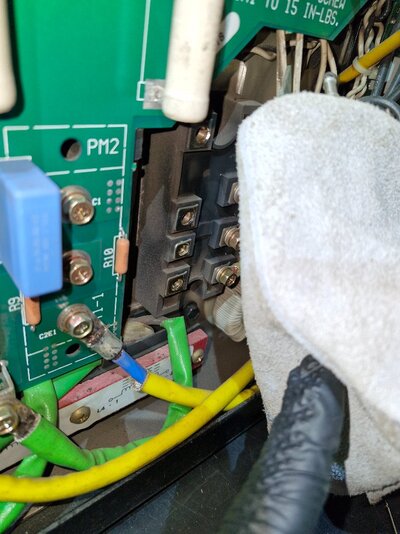
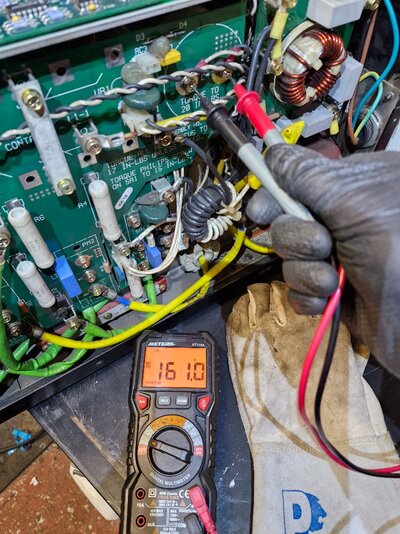
You then attached the board, and saw 161v and 162v across C3 and C4 respectively?
Correct, like this
If so, that is fine because the sum of those two voltages is 323v, which is about the correct result for the peak of 221 volts when smoothed by capacitors ( RMS x square root of 2, i.e. x 1.414 ). The capacitors were connected up when that board was put back on.The two capacitors are in series, and so about half of the DC bus value will appear across each one.
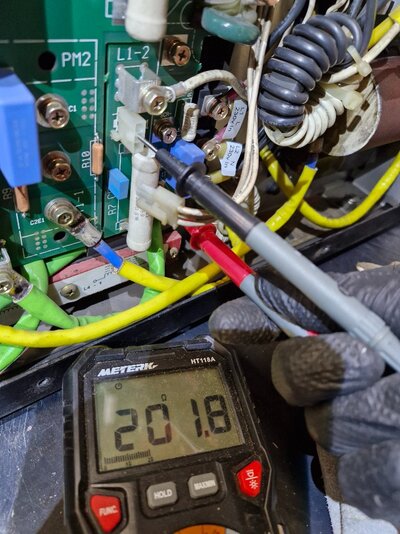
I think the 200 Ohm precharge resistor is R12, right there on that connector board?
Yes its the large white cylinder here 200ohm and on the mini board itself
See second photo in Post#1 here:
It is odd that after going to the trouble of using a bridge rectifier with a built-in precharge thyristor, Miller have used a relay anyway ( albeit a much smaller one than would have been needed to short the precharge resistor without the help of the thyristor ).
Since the thyristor gate is driven by a relay, the "pulse" will be quite long, and maybe it can be seen on a DVM. In fact, it could even be a steady high.... The trigger signal is positive on the Gate and negative on the Cathode - which is labelled "SCR(-)" on the SR1 rectifier module.
The precharge timer circuit consists of a capacitor C49, Schmitt trigger U9, and NPN driver transistor Q28. This transistor is about 2 inches below the relay in your photo in Post #55, and it looks physically OK. A voltmeter across the Collector ( relay and diode anode ) to the Emitter ( Gnd. ) should show 10 or 12 volts during the initial power-on precharge delay, and then drop to less than a volt after a couple of seconds, when the transistor turns on and the relay pulls in.
P.S. In comparing the 221 volts DC supply with the "160v" bus voltage and calling that "about two thirds", AI does not seem to take into account the difference between RMS and Peak voltages, giving no credit for the even partially-full capacitors....and if this "missing voltage" was all being dropped across the precharge resistor, it would be getting really hot.
I will go back after work to trying to trace the components on the circuit board that lead from the relay coil terminals.
I do also wonder if me applying wrong polarity to test the relay coil may have inadvertantly created this low voltage on the switching side.... I guess I need to trace and fix that first, get the relay closing and go from there. (Could still have another issue on the gate side when the relay closes)
The Owon HDS272S oscilloscope will be a useful tool for you, and being battery-powered and in a plastic case, there are no concerns about accidentally shorting mains voltages on inverters to ground with the probe "earth" clip!
If the precharge timer control circuit on Page 92 of the Service Manual does apply to your machine, only transistor Q28 is involved.
Transistor Q27 is in a Darlington Pair with Q29 on Page 94.
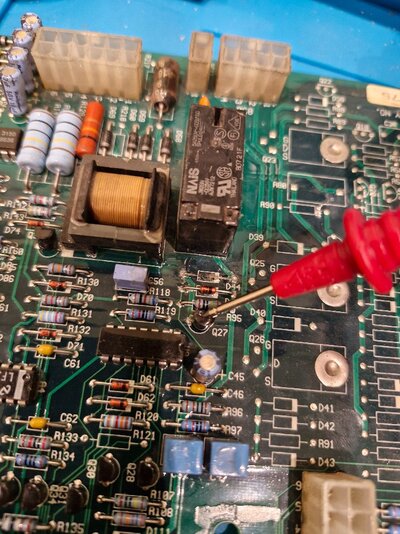
However: diode D44, just above Q27, does not look too good? It is a Zener diode, part of the Error and Compensation Amplifier on Page 95. It should test as a normal diode, conducting one way and blocking the other way, until a specific ( but unknown... ) Zener reverse voltage is reached, when it will break down and conduct in reverse.
Now that we know the total DC bus voltage across both capacitors is 323v, which is close to the expected value, I think we should step back a moment and confirm that the precharge bypass thyristor has not, or has, been triggered. If it is not conducting, the bus voltage is being reduced by the voltage drop across the 200 Ohm precharge resistor. When not welding, we don't know how much current the idle inverter is pulling, but if it is, for example, 0.1 A, then from V=IR, there should be 20 volts across that 200 Ohm resistor, and if it was shorted by the thyristor, that would drop to nearly zero and the bus voltage across C3 and C4 would rise to 343 volts.
Could you please check the voltage across the precharge resistor, as in your Post #40, but measuring DC volts and with the machine powered up? The voltage should jump to a high value with the initial current surge into the empty capacitors, then drop exponentially, then - hopefully - fall to zero when ( if ) the thyristor shorts it. An old-fashioned analogue voltmeter would probably show this better than a digital meter.
If the precharge timer control circuit on Page 92 of the Service Manual does apply to your machine, only transistor Q28 is involved.
Transistor Q27 is in a Darlington Pair with Q29 on Page 94.
However: diode D44, just above Q27, does not look too good? It is a Zener diode, part of the Error and Compensation Amplifier on Page 95. It should test as a normal diode, conducting one way and blocking the other way, until a specific ( but unknown... ) Zener reverse voltage is reached, when it will break down and conduct in reverse.
Now that we know the total DC bus voltage across both capacitors is 323v, which is close to the expected value, I think we should step back a moment and confirm that the precharge bypass thyristor has not, or has, been triggered. If it is not conducting, the bus voltage is being reduced by the voltage drop across the 200 Ohm precharge resistor. When not welding, we don't know how much current the idle inverter is pulling, but if it is, for example, 0.1 A, then from V=IR, there should be 20 volts across that 200 Ohm resistor, and if it was shorted by the thyristor, that would drop to nearly zero and the bus voltage across C3 and C4 would rise to 343 volts.
Could you please check the voltage across the precharge resistor, as in your Post #40, but measuring DC volts and with the machine powered up? The voltage should jump to a high value with the initial current surge into the empty capacitors, then drop exponentially, then - hopefully - fall to zero when ( if ) the thyristor shorts it. An old-fashioned analogue voltmeter would probably show this better than a digital meter.