


Welding Cast Iron
There are many different cast irons, many of which are totally unweldable as they will crack when you heat them. Fortunately by far the most common and the most frequently used for car components (bell housings etc) is called Nodular or SG Iron.
Nodular Cast Iron is modified by adding an innoculant just before casting (Magnesium or Cerium) which changes the shape of the graphite flakes from pointed (stress raiser) to spheroidal (hence SG or Spheroidal Graphite). This grade welds relatively easily but there is a knack to it:
- Keep it cool not cold (around 50°C is a good indicator).
- Avoid long runs, 25mm max.
- Balance the welds across the joint - start at one end and then weld a bit at the opposite end.
- Use specialist Nickel Iron electrodes that run on low current. (MIG has no speed advantage and a coil of wire will be upwards of £1000.)
- After every weld peen the bead (tap it lightly with the round part of a ball pein hammer). When preparing the joint grind out the surface to be welded so you get a full penetration weld.
- If it’s a crack repair, grind out the crack, drill the ends to stop it propagating, and allow to cool to room temperature after every weld.
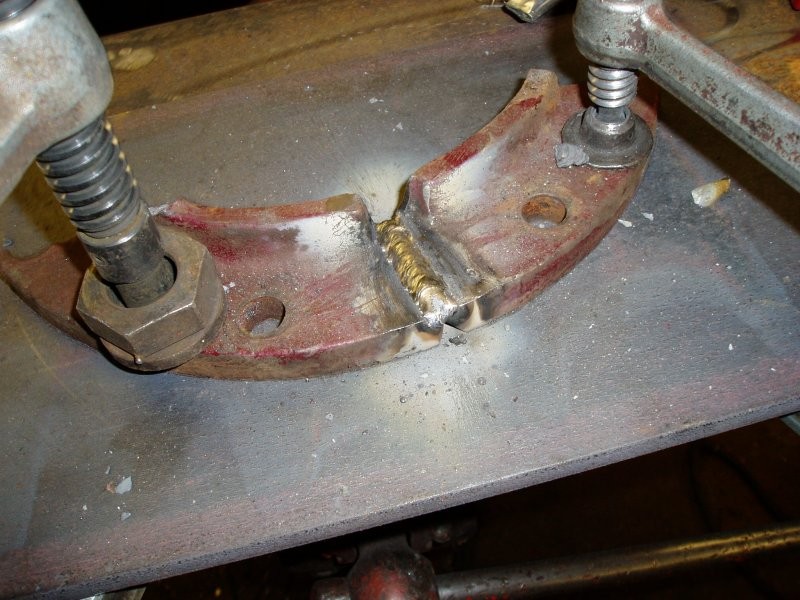
Casting repair using Lincoln Cast (Nickel Iron) Rods. (W.H.Hannaford)
Preheat or Not?
To preheat effectively you need to heat the casting to 500°C (I wouldn’t fancy trying to weld it when its that hot). Also the preheat has to be applied consistently, no hot spots or cold spots. Castings are usually variable section thickness so the thick bits need to be the same temperature as the thin bits. Really the only way to effectively preheat is to use an oven / furnace which makes it very difficult. Therefore the cool method is the most widely used.
The weld metal filler specifically designed for cast iron is either pure nickel or nickel-iron. It is possible to use mild steel but it will pick up carbon from the cast iron and become very hard and brittle which makes it crack sensitive and very difficult to grind back to shape. Nickel blocks the migration of carbon therefore it doesn’t become brittle, even the nickel-iron alloy, so it can be machined and it retains its elasticity.
The electode coatings used are designed to promote operation at low currents and consist mainly of graphite which is an excellent electrical conductor. Why is this type of coating only used on cast iron rods? For exactly the same reason as mentioned in the earlier paragraph. Graphite would add carbon to, and embrittle, virtually any steel but not nickel rich alloys.
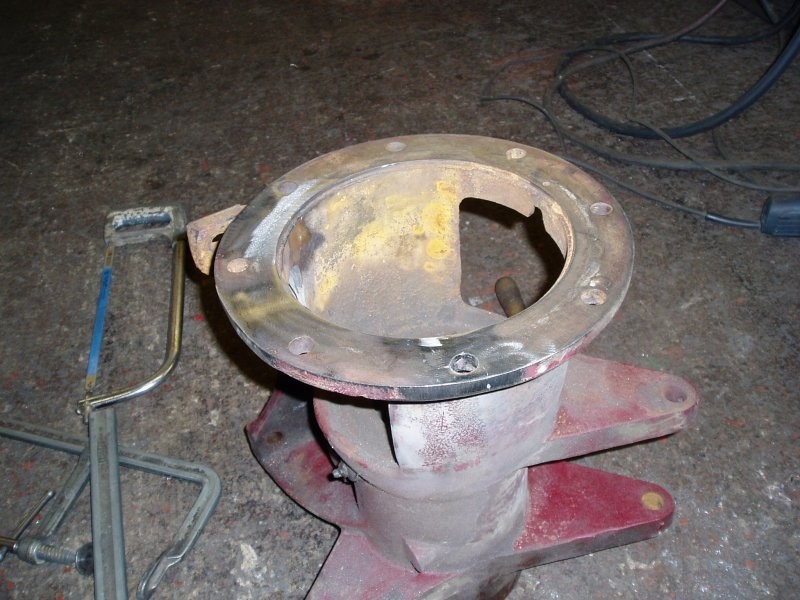
The completed repair. (W.H.Hannaford)


