
Hydrogen Embrittlement and Low Hydrogen Consumables
Hydrogen embrittles steel and in certain circumstances can actually cause the steel to crack.
Where does the Hydrogen come from?
In welding consumables with a flux the major source is the flux. Most fluxes consist of various minerals, chemicals and alloys which are glued together with a chemical known as Sodium or Potassium Silicate (sometimes called WaterGlass). It is the major component of washing powder (Daz etc).
To obtain the correct consistency there is a significant proportion of water (H2O). This is termed loose moisture, in that it can be removed by heating to above boiling point (ie 100°C).
However, there is another more difficult moisture. Some minerals contain chemically combined moisture. The moisture molecule is actually part of the mineral. To remove this you need to bake to at least 350°C sometimes higher and these chemicals will always want to recombine with this moisture. Like an alcoholic can stay dry but given the chance will take a drink. The chance comes when exposed to damp atmospheric conditions.
For this reason these types of minerals are avoided when making low hydrogen welding consumables, however, sometimes the mineral has to be added to make the consumable work. If we had “NO HYDROGEN” consumables they wouldn't weld very well.
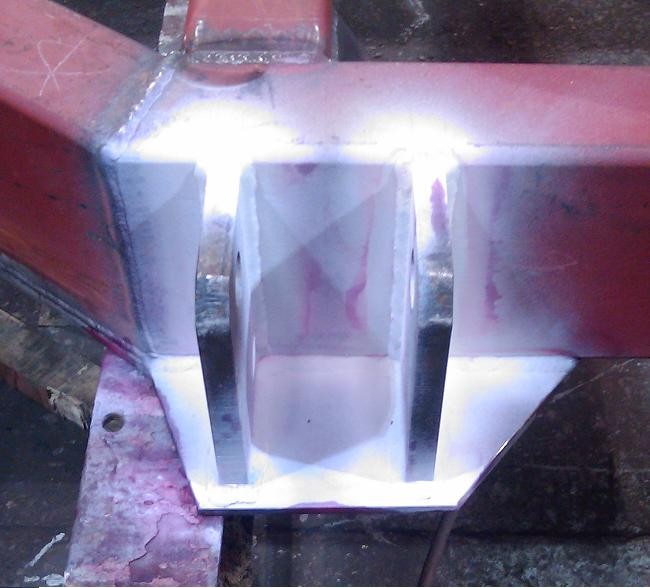
Testing a lifting eye for cracks using dye penetrant
Wires are drawn (a process of reducing the diameter) and this needs a lubricant. The lubricant is known as soap and does contain soap amongst other things. This is the main source of hydrogen in MIG wires and a secondary source in flux cored wires. Wires that feel 'sticky' will almost certainly evolve significant amounts of hydrogen. Otherwise MIG wire is one of the lowest Hydrogen contributors where 1ml / 100g weld metal is quite normal. In fluxes 3 ml / 100g weld metal is considered to be excellent, whilst less than 5 ml is the standard lower limit.
Another source is the atmosphere. The greater the humidity to greater the chance of increasing the hydrogen in a weld. Bridges over rivers are particularly prone.
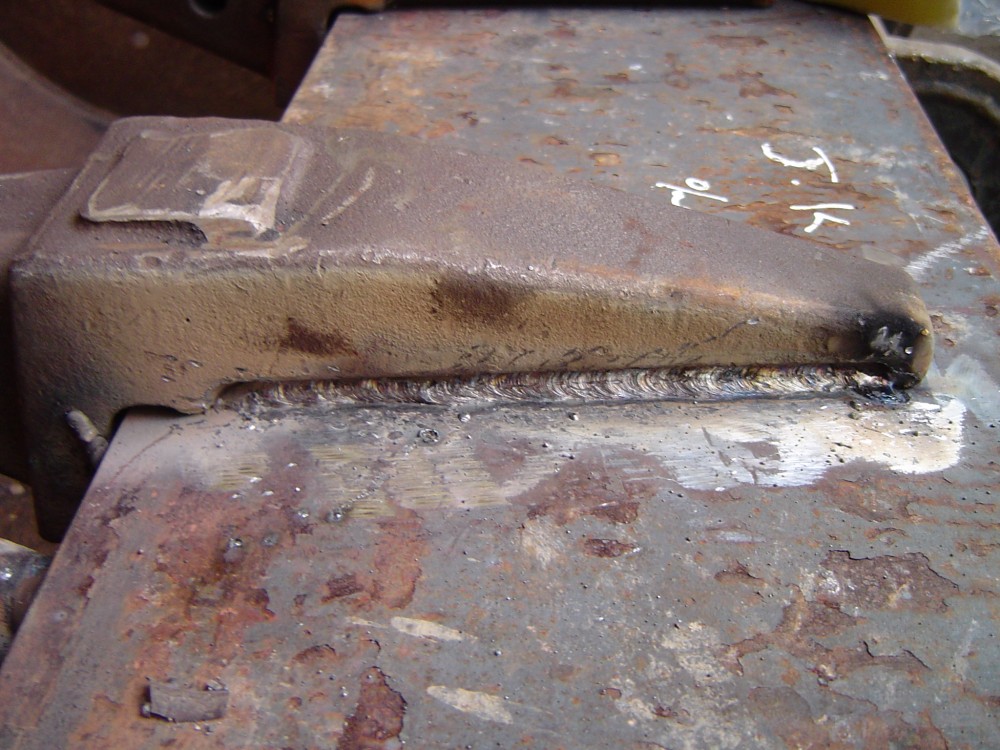
Root using low hydrogen rod. (E.T Brown and Son)
What makes the weld crack?
The science is very complex and difficult to understand even for a Metallurgist but the technology has been tamed and is fairly easy to control.
Hydrogen is very easily dissolved by molten steel (austenite) and remains dissolved until the structure changes from the austenite to ferrite (at this point the steel is solid, about 900°C). At that point the hydrogen becomes insoluble and wants to get out.
The measurement is milliliters of hydrogen per 100g of weld metal and I said 5ml is considered low. If you put a weld in glycerine you can actually see the hydrogen coming out and 5ml looks like very fizzy lemonade (it actually needs freezing first). Its amazing how many bubbles 5ml will generate. Imagine this is trapped in the steel. It needs to get out and eventually. Like over-inflating a balloon, it will burst its way out.
Some steels can tolerate more hydrogen than others. In general the softer the steel the better it can cope. It can be stretched.

Fatigue crack in digger quick hitch originating at the edge of a weld
Another factor is stress. All welds will be stressed but some joints are naturally more stressed than others and some are badly designed. The least stressed are those that can move. The greatest stresses are very rigid joints and especially the last part of a structure. For example if you were welding shut a manhole cover. The first side would be able to move, the next one would be held by the first weld. And so on until to get to the last side. This would be very rigid and contain the highest stresses. Partial penetration joints (notches) significantly increase these stresses and attract hydrogen so are particularly prone points.
We have 3 factors that contribute to making a crack:
- The steel. The harder the more prone
- The amount of Hydrogen. The greater the volume the more likely it is to cause cracking
- The stress level of the joint. The more rigid the more likely. Notches are stress raisers and intensify the effect.
So how do we stop Hydrogen cracking?
We need all 3 factors to cause the crack. One factor can be massive whilst the other two can be minimal. Significantly remove one of the factors and we significantly reduce the susceptibility.
- Use soft steel. S235, S275, s355 or the old 43, 50, 55 series are soft and highly unlikely to crack. Sometimes you need harder steel so in these cases you need to reduce the other factors.
- Reduce the stress. Allow the joint to move and eliminate stress raisers such as notches. Preheating reduces the stresses by reducing the thermal shock. Higher strength steel increases rigidity and therefore stresses.
- Allow the Hydrogen to diffuse out of the steel. Keep it warm, again preheating
will increase the time for diffusion. Allow it to cool slowly after welding,
pack it in sand.
Use low hydrogen consumables. - Use austenitic steel consumables (Stainless E309, E312, E308Mo, E307). These compositions have the ability to absorb the hydrogen within the steels structure.
- Use high heat input processes or parameters.