

Aye, though as @Seadog has said fretting would be the likely mode of failure: the tube is subject to various forces - vibration on undulating road surfaces, short duration high loads when hitting a pothole or road defect, centrifugal force and increase in pressure with heat if used hard which will result in fretting between the spoke sitting proud and the rim tape then tube. I have never used spokes sticking proud like that, so have never had a failure - no way would I risk those protruding spokes.Normal road bike tyre pressures tend to be in the 30 to 40 PSI range. That amount of spoke protrusion wouldn't lead to a puncture. The inner tube would conform around the end of the spoke. 40 PSI is around 0.06 pounds (or 27 grams) per square mm, so around 85 grams against a 2mm diameter spoke end. Rounding off any sharp spoke edges with a file should be enough. Having said that, I would still be inclined to reduce the amount of protrusion, using a hacksaw and file.
That's shockingly bad, and frankly it should be forcibly inserted into any available orifice on whoever did it.We had two new wheels built, all good, but a few of the stainless spokes extend too far and will damage the inner tube. How is it best to cut/ grind the excess off? I'm assuming too much grinding will cause heat and possible distortion?
Thanks for any advice, Chris
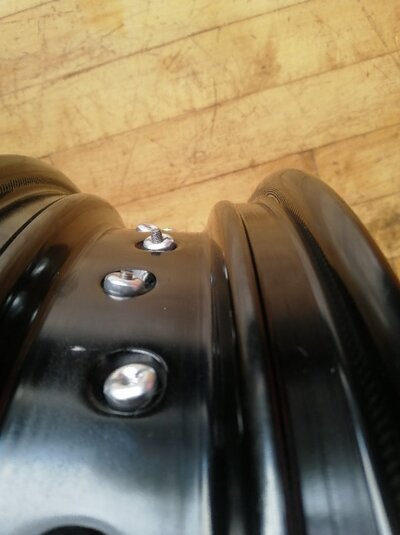
View attachment 534393
Definitely would not take the risk with the spokes like that. IMHO should be pretty much perfect for competition use, especially if you've paid someone to build the wheels.The bike's going to be used for tarmac hill climb, tyres low pressure but still he'll be pushing the bike hard
I don't know in South Wales, but I use Staffordshire Wheelworks and he does a lot of stuff that gets posted in.Thanks for the replies all.
These are the first wheels we've had built, clearly not a good job. It's a couple of hours drive to take them back and tbh, I'm not interested in someone who can't do the job properly fiddling with them any more. The bike's going to be used for tarmac hill climb, tyres low pressure but still he'll be pushing the bike hard. So no room for maybes as far as I'm concerned.
The rear wheel had none of the stick-out issue, and he's fitting the tyre right now so he can check the offset (they're supermoto wheels going on an 1989 RM 250, with a wide rear tyre).
If I can, I'll get a more local and reliable builder to sort the front wheel, whatever that'll take.
Can anyone recommend someone in South Wales who can do the job properly?
Thanks.
On the rear wheel, none of the spokes stick through but the nuts/ nipples are the same as in the photo. Is that in itself potentially hazardous?the wrong nuts/nipples have been used for the rim type as they're sticking proud of the rim well too. The nut domes should be at most flush, and the spoke ends should be a couple of mm below the surface of the dome and rim tape should be fitted over the top.
Yes, although less so.On the rear wheel, none of the spokes stick through but the nuts/ nipples are the same as in the photo. Is that in itself potentially hazardous?

Thanks Cato. So we know, if the rear wheel is offset as I described above, should the front wheel also be offset or is it ok as standard?Yes, although less so.
The issue (as other mentioned above) is chaffing. The tyre and tube move side to side quite a bit in use and they also heat up. Any point/lump that touches the tube heats up much more due to the localised friction, that creates a weak spot as the rubber is much hotter, which can then burst. Much more dangerous than a puncture as the tube splits at that point so rather than deflating it goes flat instantly. You can imagine the rest.
Basically what you're after is a nice flat, smooth surface that the tube can move about on.
That's a huge barrel of worms to open.Thanks Cato. So we know, if the rear wheel is offset as I described above, should the front wheel also be offset or is it ok as standard?
There are two schools of thought, 1) Perfectly aligned is the only acceptable set up. 2) It doesn't matter as long as the rider is unlikely to notice and they'll adapt.