

Maker
Most folk just call me; Orange Joe
- Messages
- 10,678
- Location
- Keeler crater
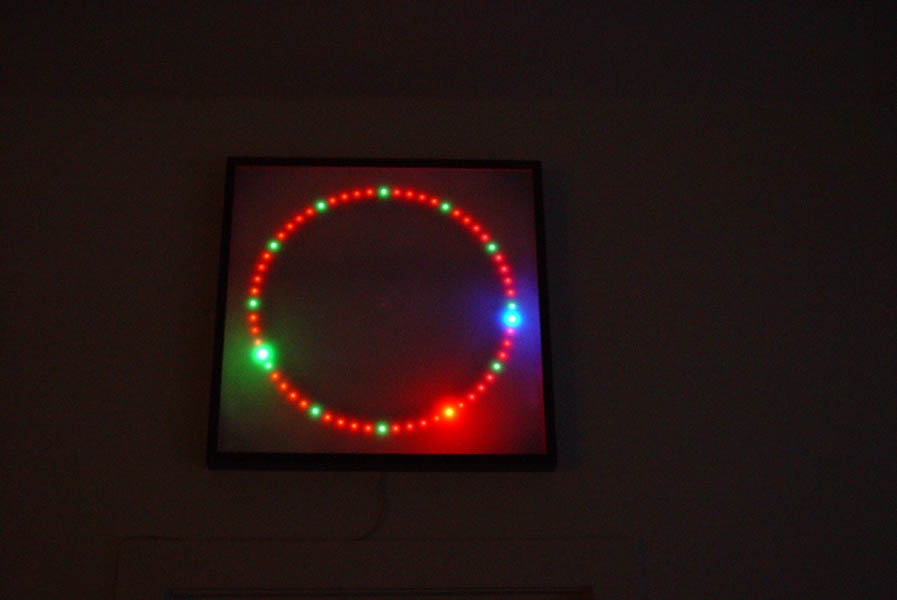
For ages now I've wanted to make a clock from a ring of 60 full colour LEDs with different colours to represent the hour, minute and second hands (If that makes sense ). The problem is I don't know how
 .
.
I was thinking of multiplexing as explained in these videos:
Connect all the cathodes for each colour (Using common anode LEDs) to each other with a transistor to connect them to GND (such that by changing which transistor is powered, the colours would change) and wire the 60 anodes to a 6x10 grid of transistors, then connect these 6 and 10 sides to another two grids of 3x2 and 5x2 so that only 15 μC pins are needed. It sounds simple in my head but then I've got no idea how write an Arduino sketch to run it.
Can someone help me understand how to write the code?
Or would an alternative method be better? Like a crapload of shift registers?
(Please don't go off topic talking about Ahmed Mohamed )
)
). The problem is I don't know how.I was thinking of multiplexing as explained in these videos:
Connect all the cathodes for each colour (Using common anode LEDs) to each other with a transistor to connect them to GND (such that by changing which transistor is powered, the colours would change) and wire the 60 anodes to a 6x10 grid of transistors, then connect these 6 and 10 sides to another two grids of 3x2 and 5x2 so that only 15 μC pins are needed. It sounds simple in my head
but then I've got no idea how write an Arduino sketch to run it.Can someone help me understand how to write the code?
Or would an alternative method be better? Like a crapload of shift registers
?(Please don't go off topic talking about Ahmed Mohamed
)



 .
.  . It could be quite easily shortened I think and I haven't looked for bugs in it yet but it works in my head
 .
.


 .
.