
Go Back   MIG Welding Forum > Welders and Equipment > Shielding Gas

Reply
 
  #1
Old 17-07-2009, 8:27 PM
malcolm's Avatar
malcolm
use approved tiger only
Admin
 
Join Date: Mar 2005
Location: Bedford UK
Posts: 6,892
Exclamation CO2 Thin Metal Warning

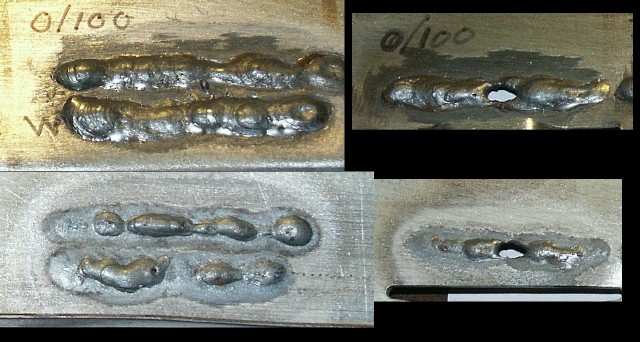
BChild came over this afternoon for a little welding and brought his Cosmo 170 running CO2. We started off on 2mm sheet and all went well, but moving to 0.8mm we discovered a big problem with CO2. The welder didn't work on the bottom power setting at all - it would lay weld on top of the metal with no penetration, and it was impossible to adjust the wire speed to give a consistent weld.

Second lowest power setting worked intermittently. It would sometimes lay weld on top of the steel and sometimes weld OK (and then blow holes - 2nd setting is not good for 0.8mm sheet). After scratching of heads we connected Argoshield to the Cosmo. That made it work. It'll be the Cosmo thought I, so we connected the CO2 bottle to my Portamig 181. Exactly the same problem!

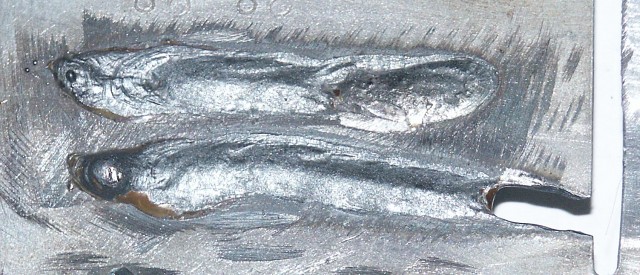
See the photo comparing CO2 and Argoshield on the Portamig. Same settings used. A video would have been better as the metal transfer modes seemed very different - CO2 just wasn't working. BChild has an identical looking coupon done with the Cosmo.

Anyone who has compared the gasses will know the arc is less stable with CO2, but it seems it doesn't work at all for low voltages (thin metal welding). Presumably not enough voltage on the lowest settings for a workable arc. It seemed to not arc until the wire touched the work, then it burned back and the process repeated. Not anything like welding.

From 1.5mm steel upwards, and maybe 1.2mm at a pinch, CO2 works, not as neat or as smooth perhaps, but more economical. For anyone using CO2 and having trouble with their lowest power settings it's very possible the gas is your trouble.

I'll update the gas comparison page (did that work on 1.5mm sheet and didn't notice this problem).
Attached Images
 

Last edited by malcolm; 17-07-2009 at 9:49 PM.
Reply With Quote
  #2
Old 17-07-2009, 10:12 PM
Specialist
Member
 
Join Date: Feb 2009
Location: Europe, Cro
Posts: 46
 
I can add to this that it is a very well known problem with thin metal and CO2; solution is to change to mix or to considerably slow down wire speed (quite much lower then normal). In my case, I have worked with CO2 and 0.8 mm wire on 0.9 mm metal pretty successful, upping the amperage to about 60A. Need to move the torch quickly to prevent burn trough and keep it steady, otherwise it works. To sum it up, thicker wire adds more metal, keeps from "thinning" out the base material too much and burning trough, higher amperage together with slower wire speed makes fusing faster and gives transfer that is more TIG-like (transfer pulses are spaced wider apart, caused by short circuit transfer with greater pauses, effectively pulsing the weld pool). In effect, since CO2 does not work on such low power settings, you are upping it and compensating for too much amperage by turning down wire speed more then usual.

So, in that mode, setting of your wire speed will need to be much lower then usual, maybe even the slowest might be a bit too much for that low power setting - that is probably why you noticed it did and then did not work intermittently, and as soon as you up the amperage (or to be precise, voltage), the problem goes away.

Better solution is to use gas mix, but not always economical. I cant afford it for my repair projects, so I stick with CO2, much more economical.
Reply With Quote
  #3
Old 17-07-2009, 10:18 PM
shenion's Avatar
shenion
Tool Pack Rat
 
Join Date: Jan 2007
Location: Stone Mountain, GA USA
Posts: 4,792
 
Are you sure it is pure CO2 not nitrogen/CO2?

I had no problems doing thin metal with pure CO2 on a Clarke.

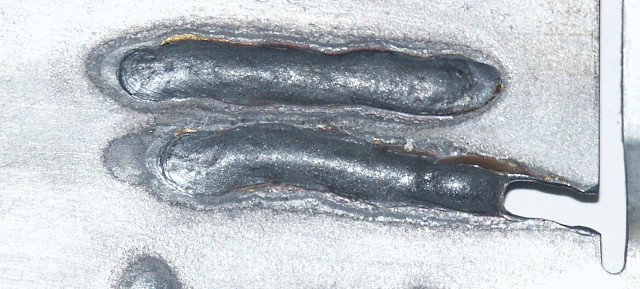
Top: (0.8mm steel)

Bottom:


With pure CO2, the current is reduced as CO2 has a lower conductance (hence lower arc stability.) The above were on the '2' setting of my 130EN.

Wire speed also needed to be considerably lower as the lower current density requires a lower wire speed to maintain the right arc duty cycle. It also has a small speed range, so a smooth wire feeder is needed.
__________________
Scott Henion - My welding Pages - DIY-Welder
Reply With Quote
  #4
Old 17-07-2009, 10:22 PM
malcolm's Avatar
malcolm
use approved tiger only
Admin
 
Join Date: Mar 2005
Location: Bedford UK
Posts: 6,892
 
Quote:
Originally Posted by shenion View Post
Are you sure it is pure CO2 not nitrogen/CO2?
The bottle said CO2 for food use. Did wonder if it was a mix of some sort but Nitrogen wasn't mentioned.

Tried a good range of wire speeds and none worked at all. You have me suspicious about the gas.
Reply With Quote
  #5
Old 17-07-2009, 10:25 PM
shenion's Avatar
shenion
Tool Pack Rat
 
Join Date: Jan 2007
Location: Stone Mountain, GA USA
Posts: 4,792
 
I was supriesed how well the clarked work, almost no spatter. It does need a large inductance to maintain the current; something a cheap welder will skimp on.

Maybe a test with a disposable CO2 might be worth the cost.
__________________
Scott Henion - My welding Pages - DIY-Welder
Reply With Quote
  #6
Old 17-07-2009, 10:27 PM
Specialist
Member
 
Join Date: Feb 2009
Location: Europe, Cro
Posts: 46
 
I'm using an industrial grade CO2, 99.9% pure. Same problems as first described, so it must have something in common.
Reply With Quote
  #7
Old 17-07-2009, 10:32 PM
shenion's Avatar
shenion
Tool Pack Rat
 
Join Date: Jan 2007
Location: Stone Mountain, GA USA
Posts: 4,792
 
You will find the torch gap must be held constant.

It is difficult on thin as you need to maintain a very consistent torch speed. Too slow and the weld pool widens out and drops out. Too fast and it just sits on top.

I found higher current settings and faster travel easier.

You are probably getting down to 20A where MIG does not work well. I had the same problems with Ar/CO2 mix when I went down that low. Seems CO2 drops the current by about 20%.

Try a short torch length, seems to work better. I have not tried 0.6mm wire with CO2, I think it may work better as you can get the voltage up but still have a lower current. Higher voltage will make the arc more stable.
__________________
Scott Henion - My welding Pages - DIY-Welder
Reply With Quote
  #8
Old 18-07-2009, 9:15 AM
malcolm's Avatar
malcolm
use approved tiger only
Admin
 
Join Date: Mar 2005
Location: Bedford UK
Posts: 6,892
 
I think this problem was the main reason BChild came over for help with welding. On the second lowest power setting on his Cosmo a reasonable weld could be achieved, but I think that setting was right on the voltage limit for the arc and it needed a higher wire speed than desirabe, tended to start sttting on top of the metal before getting into a more stable arc (though that might partly be because the wire took 3 seconds to get to speed on that machine!).

On the lowest setting the machine was into a completely different wire transfer mode as Specialist described - it was not possible to maintain an arc, instead the mode seemed to be touch, melt, burnback regardless of wire speed or technique. A video would have shown the problem better.

Surprised me too - I think my gas comparison was also done using a Clarke on the second setting and I didn't get this problem. I reproduced the problem on the lowest setting of the Portamig. Have you tried the Clarke on minimum setting on 0.8 using pure CO2?
Reply With Quote
  #9
Old 18-07-2009, 2:44 PM
shenion's Avatar
shenion
Tool Pack Rat
 
Join Date: Jan 2007
Location: Stone Mountain, GA USA
Posts: 4,792
 
Here was the Clarke on the lowest setting:


I probably could have upped the wire speed a bit. Herd thing with CO2 is it the entire weld pool is hotter opposed to argon that is hot in the center. So penetration is all or nothing.

Try joining 2 pieces together, should require less heat.

I don't have my Clarke anymore or I would run the tests again with 0.6mm wire. I can do it on my Miller if you would like.
__________________
Scott Henion - My welding Pages - DIY-Welder
Reply With Quote
  #10
Old 18-07-2009, 3:08 PM
malcolm's Avatar
malcolm
use approved tiger only
Admin
 
Join Date: Mar 2005
Location: Bedford UK
Posts: 6,892
 
That's interesting - you've had noticed the issue had it occurred in your tests - the welder simply stops working as a welder - this isn't a technique thing.

The CO2 we used should have been nearly 100% pure if it was sold as food grade. Perhaps some welders might be more suitable for use with CO2 than others?

The Clarke has capacitors on the earth, while both the Portamig and Cosmo have choke transformers. The capacitors affect measured OCV, so maybe give enough volts to run CO2 on the low settings?
Reply With Quote
Reply


Thread Tools


Similar Threads
Thread Thread Starter Forum Replies Last Post
Help with thin metal! SUZUKI ROCKS Learning MIG Welding 1 14-06-2009 8:09 PM
Welding thin metal Boris Tools, Materials and Techniques 1 19-07-2008 8:23 PM
Welding thin metal and overheating David230 MIG Welding 7 03-03-2007 2:54 PM
Which Mig for very thin metal/car panels? boombang Buying a Welder 11 23-02-2007 1:02 AM
Thin metal success kernowcam MIG Welding 0 11-12-2005 9:52 AM


All times are GMT +1. The time now is 8:30 PM.


Powered by vBulletin® Version 4.0.5
Copyright ©2000 - 2010, Jelsoft Enterprises Ltd.